

Buying an existing business can be an attractive alternative to starting one from scratch. Instead of building a customer base, brand, team, and revenue stream from zero, you may be able to acquire a company that already has customers and established operations.
But one question comes up before almost every acquisition: how much money do I need to buy a business?
The answer depends on the purchase price, financing method, business performance, lender requirements, and how much cash you need after closing. You may not need enough money to pay the entire purchase price yourself, but you should generally expect to contribute some of your own capital and maintain additional funds for working capital and unexpected expenses.
How Much Cash Do You Need to Buy a Business?
There is no universal minimum amount. A small business might be purchased for tens of thousands of dollars, while an established company can cost hundreds of thousands or even millions.
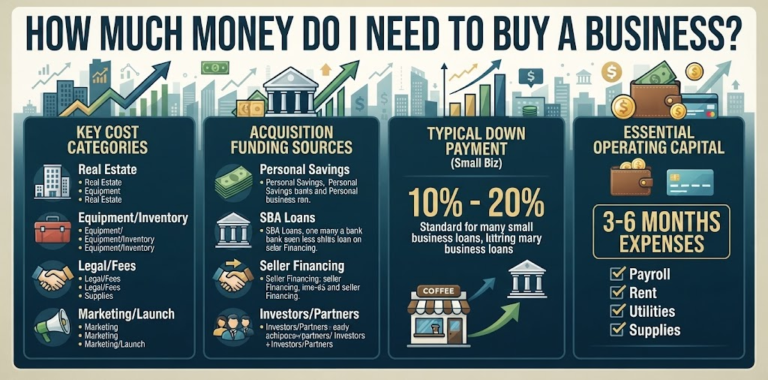
For a financed acquisition, buyers commonly need money for:
- Down payment or equity contribution
- Working capital
- Due diligence
- Legal and accounting fees
- Loan and closing costs
- Licenses and permits
- Insurance
- Initial inventory or equipment needs
For example, if a business costs $350,000 and your financing requires a 15% buyer contribution, your initial equity would be about $52,500. You would still need additional cash reserves for operating expenses and transaction costs.
That is why the purchase price alone should never be treated as your total acquisition budget.
Understanding the Down Payment
The down payment is often the biggest upfront expense for a buyer using financing.
SBA-backed financing can sometimes allow qualified buyers to acquire businesses with a relatively modest equity contribution compared with paying the entire purchase price in cash. However, the exact amount depends on the transaction, lender, borrower qualifications, and current program requirements.
Traditional bank financing may require different levels of equity and can place greater emphasis on credit history, collateral, business cash flow, and the buyer’s financial position.
Before making an offer, ask lenders exactly how much cash they expect you to contribute and whether they require additional post-closing liquidity.
Don’t Forget Working Capital
One of the biggest mistakes first-time buyers make is putting nearly all of their available cash into the acquisition.
A business still needs money to operate after you take ownership.
Working capital can help cover expenses such as:
- Payroll
- Rent
- Utilities
- Inventory
- Marketing
- Supplier payments
- Repairs
- Unexpected operating costs
The amount you need depends heavily on the type of business. A service company with limited inventory may require less working capital than a retail or manufacturing operation.
A good acquisition budget therefore includes both the money required to close the deal and a cash cushion for running the company afterward.
How Much Does an Average Business Cost?
Business prices vary enormously by industry, location, profitability, assets, and growth prospects.
BizBuySell’s historical transaction data provides useful insight into the U.S. small-business market. Its reports track businesses listed for sale as well as businesses that have completed transactions.
Rather than assuming that every business costs a particular amount, buyers should evaluate the specific company’s cash flow, earnings, assets, liabilities, and valuation multiples.
A $200,000 business that generates strong, sustainable cash flow could be a better acquisition than a $500,000 business with weak or declining earnings.
Financing Options for Buying a Business
You don’t necessarily need to have the full purchase price sitting in your bank account. Several financing strategies may be available to qualified buyers.
SBA Financing
SBA-backed loans are commonly considered by entrepreneurs purchasing established small businesses. Depending on the transaction and borrower qualifications, they can provide longer repayment terms than some conventional financing options.
However, SBA financing is not automatic. Lenders still evaluate the buyer, the business, its financial history, repayment ability, and the overall transaction.
Traditional Bank Loans
Banks may finance business acquisitions for buyers with strong financial profiles and businesses that demonstrate reliable cash flow.
Expect lenders to review factors such as:
- Personal credit
- Business financial statements
- Debt obligations
- Collateral
- Industry experience
- Business cash flow
- Your proposed equity contribution
Seller Financing
Seller financing can sometimes reduce the amount of cash a buyer needs at closing.
Under a seller-financed arrangement, the seller agrees to receive some portion of the purchase price over time rather than receiving the entire amount immediately.
The terms vary considerably, so buyers should have an attorney and financial professional review the agreement before committing.
Using Personal Savings
Some buyers use personal savings to fund part or all of an acquisition.
Paying cash can simplify the transaction because you avoid taking on acquisition debt. However, using every dollar of your savings can leave you vulnerable if the business experiences a difficult period after closing.
Maintaining an emergency and operating reserve is therefore important.
Retirement-Based Strategies
Before using retirement funds to help finance a business purchase, buyers should understand the potential tax implications and rules involved. The IRS guidance on retirement plans can help readers understand the basic rules before discussing a strategy with a qualified financial or tax professional.
Certain retirement-account strategies may allow eligible entrepreneurs to invest retirement funds into a business. These arrangements can involve significant tax, legal, and regulatory considerations.
Anyone considering such a strategy should speak with qualified tax and legal professionals before moving forward.
A Simple Example of an Acquisition Budget
Imagine you’re interested in purchasing a business for $400,000.
Your financing arrangement requires a 15% equity contribution.
Purchase price: $400,000
15% buyer contribution: $60,000
Remaining financed amount: $340,000
Now suppose you also need:
- $20,000 for working capital
- $8,000 for professional and transaction expenses
- $7,000 for initial improvements and other costs
Your realistic cash requirement could therefore be around $95,000, rather than simply the $60,000 down payment.
This is only an example. Actual lender requirements, fees, and working-capital needs vary from one acquisition to another.
What Lenders Look for in a Buyer
Having enough money is only one part of getting acquisition financing.
Lenders may also want to see evidence that you can successfully operate and repay the loan.
Important factors can include:
Strong Personal Credit
Your personal credit history can influence how lenders assess your ability to handle debt.
Relevant Experience
Experience in the business’s industry can strengthen your application, although it isn’t always mandatory.
Clean Financial Records
Organized personal financial statements, tax returns, and business financial records can make the financing process easier.
Sufficient Cash Reserves
Having money left after closing demonstrates that you can handle unexpected expenses and temporary fluctuations in cash flow.
A Realistic Business Plan
A lender needs to understand how the business will generate enough cash to support its operations and debt payments after the acquisition.
Don’t Make the Down Payment Your Entire Budget
If you have $75,000 available, it doesn’t necessarily mean you should search for a business requiring exactly $75,000 as the down payment.
You need to consider what happens after the transaction closes.
A new owner may encounter unexpected expenses, employee changes, equipment repairs, customer losses, or seasonal fluctuations. Keeping a reserve can give you breathing room while you learn how to operate the business.
This is particularly important for first-time buyers.
How to Prepare Before Searching for a Business
Before contacting sellers, determine your financial position.
Start by calculating:
- How much cash you have available.
- How much you can comfortably use as an equity contribution.
- How much you want to keep as a personal emergency reserve.
- How much additional working capital the business may require.
- How much debt you can realistically afford.
- What type of financing you may qualify for.
Once you know these numbers, you can search for businesses that fit your actual financial capacity rather than falling in love with an acquisition you cannot comfortably finance.
Final Thoughts
So, how much money do you need to buy a business?
There is no single number that works for everyone. Your required capital depends on the purchase price, financing structure, down payment, working-capital needs, professional fees, and lender requirements.
For many financed acquisitions, the buyer’s cash requirement can be significantly lower than the full purchase price. But having enough money to close the transaction is only part of the equation. You should also have sufficient reserves to operate the business and deal with unexpected expenses.
The smartest approach is to determine your available capital first, speak with potential lenders, and then search for businesses that fit your financial position.
Important: Financing requirements change and individual transactions are different. Always verify current loan terms and obtain professional legal, tax, and financial advice before purchasing a business.
