

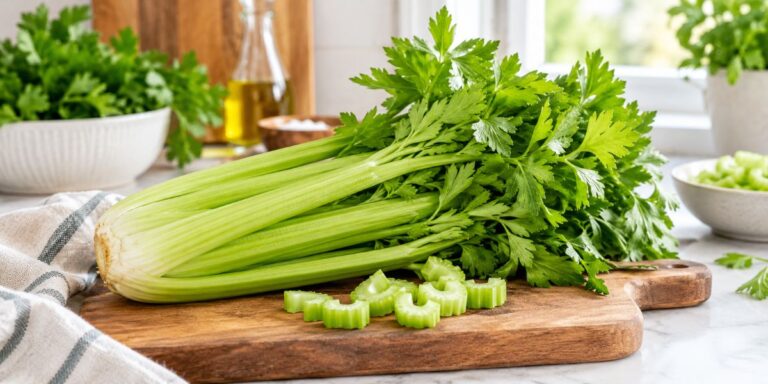
Last winter I stood in a Belgrade market holding a knobby brown root that looked like something dug out of a riverbed. The woman at the stall caught me staring. “Pravi celer,” she said, tapping it like it was obvious. Real celery.
I nodded as if I understood. I did not.
It took me a few months, a lot of soup, and some reading to work out what she meant. Now I can’t go back to the pale stalks in plastic that I used to buy without thinking.
So what does the name mean?
“Pravi” means true or real in Serbian, Croatian and Bosnian. “Celer” is celery. Put together, you get “true celery.”
It sounds simple, but the phrase carries an opinion. It says there’s a real version and there’s whatever else is sitting in the supermarket. Most of us grew up with stalk celery: crisp, watery, mild, and eaten mostly because it holds dip well. Pravi celer points to a different idea of the plant. It’s the whole thing, used properly. Root, stalks, leaves, seeds.
In practice, when a Balkan cook says celer, they very often mean celeriac, the round, hairy root (Apium graveolens var. rapaceum). It looks unfriendly. Peel it and you find a pale, dense flesh with a smell that’s earthy, a little nutty, and surprisingly strong. A cook there doesn’t ask whether to add it to the soup. It just goes in.
Why the old kitchens relied on it
Celery has been around for a very long time. The ancient Greeks wove it into garlands and treated it as medicine. Seeds were found in Egyptian tombs. It spread through Europe slowly and settled in at the cold end of the continent, where it made perfect sense.
Think about a Balkan household a few generations back. Winters are long. Fresh vegetables are scarce by January. Celeriac is one of the few things that keeps well in a cool cellar for months, and the leaves can be dried in summer and crumbled into pots all winter. Nothing about the plant goes to waste, because nobody could afford to waste it.
That’s how an ingredient moves from “nice to have” to “the thing the cuisine is built on.” Take it out of a Serbian bean soup and the whole pot tastes thin, like someone forgot the main character.
What it does in the pot
Here’s the difference I noticed first. Stalk celery gives a fresh, slightly grassy note. Celeriac gives depth. Drop a peeled chunk into a slow broth and, after an hour or so, the kitchen smells like a proper home-cooked meal. I can’t describe it better than that. It’s warm, a bit musky, and somehow familiar even if you never grew up with it.
Some ways I’ve used it since:
- In stews. Diced early, along with onion and carrot, so it melts into the base.
- Raw in salad. Grated fine and tossed with lemon juice, olive oil and a little salt. It’s crunchy and sharp, and nothing like a limp lettuce salad.
- Roasted. Cut into thick wedges until the edges go brown and sweet. Honestly, this one converted my sceptical partner.
- Mashed with potato. Half and half. It lightens the potato and adds something people can’t quite name.
- Pickled. Common in the region for winter. Sharp, salty, great next to heavy meat dishes.
The leaves are worth keeping too. Most people bin them. Dry a handful on a tray for a few days, crumble them, and you’ve got a seasoning that tastes like celery with the volume turned up. The seeds go into stocks and spice rubs.
What’s actually in it
I’m not a nutritionist, so I’ll keep this plain. Celery in its various forms has a decent amount of vitamin K, some vitamin C, potassium, folate and fibre. It’s mostly water, around 95 percent, so it’s not a calorie-dense food. It also contains plant compounds like apigenin and luteolin, which researchers have been studying for possible anti-inflammatory effects.
Be careful with the bigger claims you’ll see online. Some websites make celery sound like a cure for everything. The reality is more modest. It’s a healthy vegetable that adds flavour so you need less salt and fat, and that’s already a good deal. If you take blood thinners, remember that vitamin K matters for those medicines, so it’s worth asking your doctor about regular large amounts.
One more small thing: the leaves tend to carry more of those plant compounds than the stalks. It’s a nice reminder of how much we throw away because it looks untidy.
Can you grow it?
Yes, though it asks for patience more than skill.
Celeriac has a long season, roughly three to four months from transplant to harvest, and it needs a head start. Sow seeds indoors about ten to twelve weeks before your last frost. They’re tiny and slow, so don’t panic when nothing happens for a couple of weeks. Press them onto the surface of the soil rather than burying them, because they need light to germinate.
Once outside, give it:
- Rich soil with plenty of compost.
- Steady moisture. Celery hates drying out, and a dry spell makes the root woody.
- Mulch around the base to keep the soil cool.
- A regular feed, since it’s a hungry plant.
If you’d rather grow leaf or stalk types, the same habits apply: consistent water, good soil, and picking the outer stalks first so the inner ones keep growing. Leaf celery is the easiest of the lot, and it’s what you’d want if your main goal is that strong, aromatic flavour for cooking.
Harvest celeriac in autumn, once the roots are about the size of a large fist. Cooler weather improves the flavour. And the difference between your own and one that has spent two weeks in a supply chain is real. It smells alive.
Buying it
If you don’t have garden space, look for firm, heavy roots with as few soft spots as possible. Don’t worry about the rough skin. Smaller ones are usually less woody inside. Store it unwashed in the fridge and it’ll keep for weeks. A good Turkish, Eastern European or farmers’ market stall will often have it in autumn and winter.
To prep it, slice off the top and bottom, then cut the skin away with a sharp knife rather than a peeler, since the surface is too uneven. Drop cut pieces into water with a little lemon juice if you’re not cooking them right away, because they brown quickly.
Why the word matters
What stuck with me wasn’t a recipe. It was the fact that the phrase exists at all.
People only add “real” or “true” to a word when the original has started to disappear. Nobody talks about “real water” until bottled alternatives show up. Pravi celer is a label that appeared once cheaper, blander versions started taking the name. And the quiet loss isn’t only flavour. It’s a way of cooking, where you use every part and nothing is treated as scrap.
I don’t think the answer is to be precious about it. Supermarket celery is fine for what it is. But if you’ve ever made a soup and felt that something was missing, something you couldn’t name, try a piece of celeriac in the pot. You may find it was the missing note.
That market woman was right. It was obvious. I just hadn’t tasted it yet.
Have you cooked with celeriac before? Tell me how you used it, I’d love to hear.
