

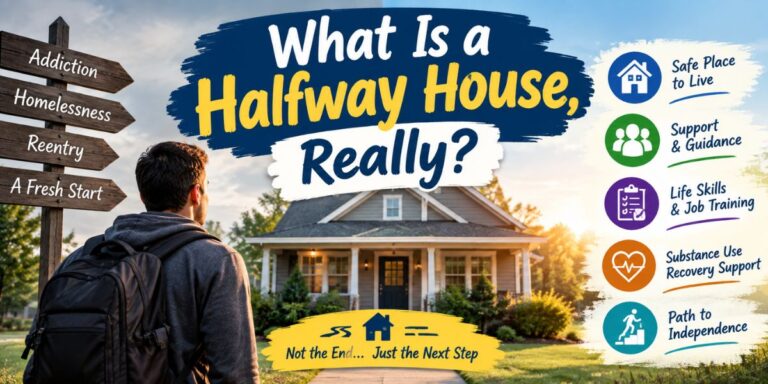
The term gets thrown around loosely, but a halfway house has a pretty specific job: it’s the bridge between somewhere highly controlled — prison, a psychiatric hospital, an inpatient rehab program — and just… living on your own again. Not quite locked-down supervision, not quite full independence. Halfway.
Who Actually Ends Up There
Three main groups tend to pass through halfway houses. People coming off a prison sentence or on parole, people who’ve finished the intensive phase of addiction treatment and need somewhere stable before going fully independent, and people stepping down from inpatient mental health care who aren’t quite ready to be entirely on their own yet.
The point isn’t punishment or extended treatment — it’s a safe, drug- and alcohol-free space where someone can rebuild the basics: hold down a job, handle their own schedule, reconnect with people, relearn the rhythm of daily life without someone managing every hour of their day. Most stays run somewhere between three and six months, though if a court or parole board is involved, that timeline might be set for you rather than chosen.
What Living There Actually Looks Like
It’s not unsupervised, but it’s not locked-facility supervision either. There’s usually staff or a house manager around, sometimes clinical support, sometimes peer support, depending on the house. What you can expect across most of them: random drug testing, curfews that are actually enforced, mandatory counseling sessions, and often a requirement to be actively job-hunting or working.
Funding varies a lot too — some houses are state-funded or run through nonprofits, others take court referrals, and a smaller number operate privately. That funding source tends to shape how strict the place is and how much say a resident has over their own routine.
Halfway House vs. Sober Living Home
People mix these up constantly, and the difference actually matters:
Getting in. Halfway houses are often court-ordered or come through a formal referral. Sober living homes are usually voluntary — you choose to be there, sometimes even voted in by current residents.
The rules. Halfway houses tend to be more regimented — mandatory classes, structured therapy, less flexibility. Sober living homes still require staying substance-free, but the day-to-day rules come more from house norms and peer accountability than a formal program.
Who’s running things. A halfway house usually has actual administrative or clinical staff overseeing operations. Sober living homes are more often peer-run, sometimes with just a house manager keeping things on track rather than a clinical team.
Bottom line: both exist to keep someone from going straight from a controlled environment into total independence with no net underneath. They just do it with a different amount of structure and a different path to getting in the door.
