

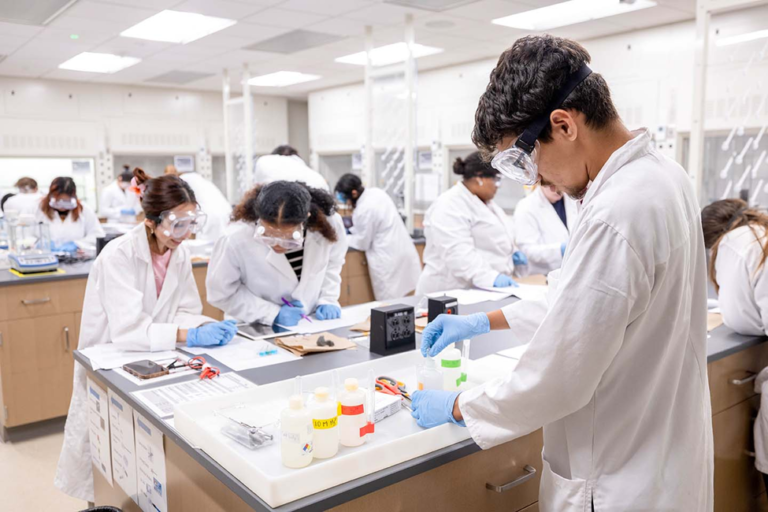
Choosing a B.S. in biology is not simply a matter of finding the most famous university. A future physician may need strong pre-health advising and room for clinical experiences, while a student interested in biotechnology may care more about molecular biology, research access, and data skills. Cost, campus size, location, and the opportunity to work closely with faculty can matter just as much as name recognition.
The Texas programs below stand out for different reasons. This is a fit-based shortlist rather than a numerical ranking. Each university offers a credible route into health-profession study, laboratory work, graduate education, or the life-science industry, but the best choice depends on the student’s intended path.
Texas biology programs at a glance
• Texas A&M University–Victoria — Best for: Students seeking an adaptable pre-health and laboratory pathway. Advantage: Human- and environmental-focused coursework with upper-level lab and research requirements.
• The University of Texas at Austin — Best for: Students who want many biology specializations. Advantage: Options spanning human biology, microbiology, genetics, computation, and cell and molecular biology.
• Texas A&M University, College Station — Best for: Students seeking a broad research-university experience. Advantage: A comprehensive curriculum from molecular biology to ecology and evolution.
• The University of Texas at Dallas — Best for: Students focused on biotechnology or molecular research. Advantage: Strong molecular and cellular emphasis, plus relevant accelerated graduate options.
• University of Houston — Best for: Students who want urban research and pre-health resources. Advantage: Multiple biology-related degrees, mentored research, and dedicated health-professions advising.
• Texas State University — Best for: Students who value broad study and experiential learning. Advantage: Flexible biology coursework with encouragement to pursue internships and undergraduate research.
• Texas Tech University — Best for: Students seeking a flexible, lab-centered biology degree. Advantage: Research opportunities in areas such as genetics and ecology.
1. Texas A&M University–Victoria: A flexible bridge between pre-health and laboratory careers
Texas A&M–Victoria offers one of the most balanced choices for students who want to keep both professional school and laboratory employment in view. Its Biology B.S. program (https://www.tamuv.edu/natural-applied-science/undergraduate-degrees/biology/) combines the standard science foundation—biology, chemistry, organic chemistry, physics, calculus, and statistics—with upper-level work in biochemistry, genetics, research methods, and biology seminar.
Students can shape part of the major around human or environmental biology. Human-focused options include subjects such as physiology, histology, immunology, medical microbiology, and cell and molecular biology, depending on course availability. The degree also requires upper-level biology laboratory work, helping students move beyond lecture-based knowledge.
That combination makes the program especially useful for someone still deciding between medical or other health-profession study, biomedical graduate school, and an entry-level laboratory path. The department also describes research interests ranging from biotechnology and genetics to microbiology, pharmaceutical science, marine ecology, and environmental science.
Best fit: Students who want a focused program with hands-on science, career flexibility, and a choice between human and environmental emphasis areas.
2. The University of Texas at Austin: Broad specialization and extensive pre-health support
UT Austin is a strong option for students who already know which branch of biology attracts them—or who want enough breadth to explore before deciding. Its Bachelor of Science in Biology includes options such as human biology, cell and molecular biology, microbiology and infectious diseases, genetics and genomics, computational biology, and ecology, evolution, and behavior.
That variety can serve very different goals. Human biology and microbiology can align naturally with pre-health interests. Cell and molecular biology, genetics, and computational biology can support students considering biotech, pharmaceutical research, or graduate study. The university also offers health-professions advising and a pre-health certificate that can complement a science major.
The main tradeoff is scale. A large research university can provide exceptional course and research variety, but students may need to take initiative when pursuing faculty mentorship, laboratory positions, and individualized guidance.
Best fit: Students who want numerous specialization choices and are comfortable navigating a large, research-intensive university.
3. Texas A&M University, College Station: A comprehensive life-science foundation
Texas A&M’s Biology B.S. is designed to cover the major branches of the field, from molecular and cellular biology to ecology and evolution. The degree is specifically positioned as preparation for biological-science graduate programs and professional study in medicine, dentistry, veterinary medicine, and related health fields.
For students who are not ready to narrow their interests too early, that breadth is valuable. It can support a pre-health course plan while preserving access to research questions outside human biology. Undergraduates can also seek traditional faculty-mentored research and course-based research experiences.
As at any large institution, opportunity does not automatically become experience. Students should investigate how first- and second-year undergraduates enter labs, how competitive particular opportunities are, and whether the advising model matches the amount of guidance they expect.
Best fit: Students who want the resources of a large research campus and a biology degree that remains broad across levels of life.
4. The University of Texas at Dallas: Molecular biology and biotechnology alignment
UT Dallas deserves close attention from students interested in the laboratory and computational side of modern biology. Its Biology B.S. centers biochemical, genetic, molecular, and cellular concepts, including the study of genes, proteins, RNA, and gene regulation. The curriculum also recognizes the importance of chemistry, physics, mathematics, and computer science in biotechnology and genetic engineering.
The program can prepare students for health-profession study, biological research, or work as research assistants in pharmaceutical, biotechnology, government, and environmental laboratories. Qualified students may also explore accelerated pathways connected to graduate programs such as biotechnology, molecular and cell biology, or bioinformatics and computational biology.
This makes UT Dallas particularly appealing to students who see biology as an increasingly quantitative discipline. Someone considering drug discovery, genomics, bioinformatics, or molecular diagnostics should compare its advanced electives and undergraduate research opportunities closely.
Best fit: Students who want molecular depth and a clear connection to biotechnology, genetic engineering, or computational bioscience.
5. University of Houston: Urban research access and health-professions advising
The University of Houston offers B.A. and B.S. degrees in biology and biochemistry, along with a B.S. in mathematical biology. Within biology and biochemistry, research spans biochemistry, cell and molecular biology, and ecology and evolution.
Undergraduates can pursue mentored research through options that include volunteering or working in a lab, a senior research project, and a senior honors thesis. The university also provides dedicated health-professions advising in addition to academic advising for science majors. That separation matters because completing a biology degree and building a competitive application to medical, dental, optometry, pharmacy, or another professional program are related but distinct projects.
Houston’s healthcare and life-science environment may also appeal to students seeking clinical, research, or industry exposure beyond campus. Prospective students should still verify how opportunities are arranged; proximity alone does not guarantee a placement.
Best fit: Self-directed students who want biology research, pre-health support, and access to a major metropolitan healthcare market.
6. Texas State University: Broad biology with experiential options
Texas State’s Biology B.S. gives students a broad range of coursework and encourages both internships and undergraduate research. The department’s larger undergraduate portfolio also includes microbiology, aquatic biology, wildlife biology, and a pre-professional program supported by pre-health advising.
For a student comparing pre-health biology degrees, this breadth creates room to develop a distinctive academic story. One student might emphasize physiology and microbiology, while another builds experience around ecology, field science, or biotechnology. Internships and research can then turn that coursework into evidence of practical skill.
Students should review the current degree plan with an advisor rather than assume that the major automatically includes every prerequisite for a particular professional school. Requirements can differ among medical, dental, physician-assistant, pharmacy, and other programs.
Best fit: Students who want a flexible biology foundation and plan to make internships or undergraduate research a central part of college.
7. Texas Tech University: Flexible study with laboratory research opportunities
Texas Tech’s Biology B.S. combines a broad STEM foundation with opportunities for laboratory research in areas such as genetics and ecology. Students may also pursue more specialized study in ecology and environmental biology.
The program can prepare students for medical school or for scientific careers, but its flexibility makes advance planning important. A pre-health student should map professional-school prerequisites early, while a biotech-focused student should prioritize molecular and cellular electives, quantitative courses, research methods, and sustained laboratory experience.
Texas Tech offers several avenues for undergraduate research through university and college initiatives. Prospective students should ask when majors typically begin research and whether opportunities are available for credit, pay, or volunteer experience.
Best fit: Students who want a flexible biology degree and are ready to build a deliberate combination of coursework and research.
What to look for in a pre-health biology degree
“Pre-health” is a goal, not usually a major. Medical and other professional schools evaluate applicants on much more than the title of their bachelor’s degree. Before enrolling, compare each program on five practical questions:
- Will the degree leave room for the prerequisites you need? Biology often overlaps with professional-school requirements, but the overlap is rarely perfect for every health field.
- Is specialized advising available? Strong pre-health advising should help with course sequencing, application timing, testing, clinical exposure, service, and recommendation planning.
- Can you protect your academic performance? A rigorous curriculum is useful, but so are tutoring, supplemental instruction, accessible faculty, and a realistic course load.
- Are clinical and service opportunities practical to reach? Look beyond a list of nearby hospitals. Ask how students actually find, schedule, and document experiences.
- Can you build relationships with faculty? Detailed recommendations usually grow from sustained academic or research relationships, not a single large lecture course.
What to look for in a biology program for biotech careers
Biotechnology employers need graduates who can do more than recall scientific concepts. Useful programs help students develop technique, judgment, documentation habits, and quantitative reasoning. Look for coursework or experiences involving:
- Genetics, molecular biology, cell biology, microbiology, and biochemistry
- Upper-level laboratory methods and safe instrument use
- Experimental design, statistics, and reproducible data analysis
- Bioinformatics, programming, or computational biology
- Faculty-mentored research, internships, or an independent capstone
- Scientific writing, presentations, and careful recordkeeping
The U.S. Bureau of Labor Statistics notes that biological technicians typically need a bachelor’s degree (https://www.bls.gov/ooh/life-physical-and-social-science/biological-technicians.htm) and that students benefit from laboratory experience while in school. More advanced research roles often require graduate education. For example, medical scientists typically hold a doctoral or professional degree (https://www.bls.gov/ooh/life-physical-and-social-science/medical-scientists.htm). A bachelor’s program should therefore be judged both as preparation for an initial job and as a foundation for later study.
How to choose among the best biology bachelor’s programs in Texas
Start with career direction, then compare the experiences that will move you toward it. A future physician may prioritize grades, prerequisite planning, clinical access, and close advising. A future biotech researcher may prioritize advanced labs, molecular coursework, computation, and early research. A student who is unsure may benefit most from a flexible program that supports both.
Finally, compare the full cost of attendance and the likelihood of graduating on time. A prestigious program is not automatically the best value if required courses are hard to schedule or the financial burden limits unpaid research, clinical service, or test preparation. Visit campuses when possible, speak with current majors, and ask departments for concrete examples of how undergraduates enter labs, internships, and professional-school preparation.
The best biology program is the one that gives you the right scientific foundation—and enough time, guidance, and access to turn that foundation into experience.
Frequently asked questions
Is a B.S. better than a B.A. for pre-med students?
Not automatically. A B.S. usually includes more required science and mathematics, which may overlap well with pre-med preparation. Medical schools generally care more about completed prerequisites, academic performance, experience, and the overall application than whether the diploma says B.A. or B.S.
Do pre-med students have to major in biology?
No. Students can major in another subject as long as they complete the required science coursework for their target schools. Biology is popular because many prerequisites fit naturally into the degree.
Which biology courses are most useful for biotechnology?
Genetics, molecular biology, cell biology, microbiology, biochemistry, statistics, and bioinformatics are especially relevant. Advanced laboratory courses and research experience are just as important because they show that a student can apply the material.
Is pre-health the same as pre-med?
No. Pre-health is a broader term that can include preparation for medicine, dentistry, pharmacy, optometry, physician-assistant programs, physical therapy, occupational therapy, veterinary medicine, and other health professions. Each path can have different prerequisites.
