

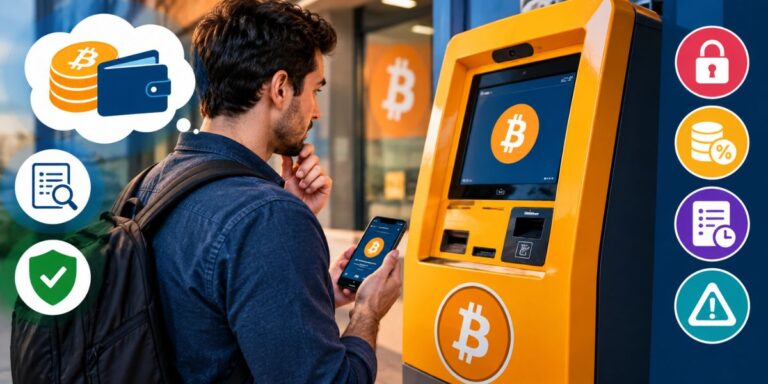
A Bitcoin ATM looks like a regular ATM, but it’s doing something completely different under the hood. Instead of dispensing cash from your bank account, it’s converting cash you feed into it into crypto — or the reverse, on machines that support selling too. It’s not linked to your bank at all. It’s really just a kiosk trading paper money for a blockchain transaction.
The Fees Are Steep — Really Steep
This is the part people underestimate the most. Bitcoin ATMs typically charge somewhere between 5% and 30% per transaction, and most land in the 15-19% range. Compare that to an online exchange, where fees are usually a small fraction of that, and it’s clear these machines are convenient, not cheap.
It doesn’t stop at the posted fee, either. The exchange rate the machine gives you is often worse than market rate — sometimes by another 20% on top of the fee itself. So the “fee” you see advertised isn’t the whole story.
There are also daily limits on how much you can convert, often capped around $5,000 unless you go through additional ID verification, which usually raises the ceiling. And once your cash goes in and the transaction completes, there’s no FDIC protection, no chargeback, nothing resembling the safety net you’d get from a bank. It’s final.
Security: Mistakes Are Permanent
Crypto transactions don’t reverse. If you send funds to the wrong address, or a scammer talks you into sending them to their wallet, that money is gone — there’s no dispute process, no calling anyone to undo it.
That irreversibility is exactly why Bitcoin ATMs have become a go-to tool for scammers. If anyone tells you to pay a bill, settle a tax debt, or resolve a “tech support” issue by walking to a crypto ATM and feeding in cash, that’s a scam, full stop. No legitimate government agency, utility, or tech company asks for payment that way. Ever.
On the legitimate side, most machines will still ask for some form of verification — a phone number for an SMS code, your name, sometimes a government ID scan for larger transactions. That’s standard KYC (know-your-customer) practice, not a red flag by itself.
How the Transaction Actually Works
- Get a wallet ready first. Install a mobile crypto wallet app — Trust Wallet, BlueWallet, or whatever the machine’s operator recommends — before you even walk up to the machine. You’ll need it to generate a receive QR code.
- Choose buy or sell. Most machines default to buying; some support both directions.
- Verify your identity. Usually just a phone number and an SMS code for smaller amounts.
- Scan your wallet’s QR code so the machine knows where to send the crypto.
- Feed in your cash, bill by bill.
- Review the total before confirming. This is where you’ll actually see the fees and exchange rate spelled out — check it before you approve.
- Take your receipt and wait. Blockchain confirmation usually takes 10 to 20 minutes, so don’t expect it to show up in your wallet instantly.
Worth Asking Yourself First
Given the fees, a Bitcoin ATM makes the most sense when convenience matters more than cost — you need crypto fast, you don’t have easy access to an online exchange, or you’re converting a small enough amount that the fee percentage doesn’t sting too much. For anything larger, it’s worth comparing what an online exchange would cost you instead, since the gap can be significant.
If you let me know whether you’re looking to buy or sell, and roughly how much cash you’re working with, I can help you compare what a Bitcoin ATM would cost versus a standard exchange for that amount.
