

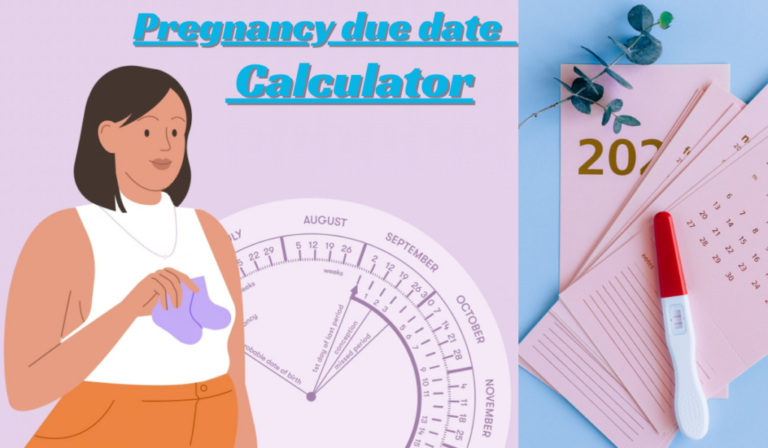
So you’ve just found out you’re pregnant, and naturally, the first thing you want to know is when the baby’s actually going to show up. Our free due date calculator gives you an instant estimate based on your last menstrual period or conception date plus how many weeks pregnant you are good now and which trimester you’re in. It seems like it should be simple — pick a date, add nine months, done. But then you plug your last period into an app and it tells you you’re “6 weeks pregnant,” and suddenly the math doesn’t feel like it adds up the way you expected. Here’s what’s actually going on, and how to work it out for yourself.
It Starts With Your Last Period, Not Conception
This is the part that trips people up first: your due date is calculated from the first day of your last menstrual period (LMP), not from the day you actually conceived. Feels a bit backwards, right? You’re not even pregnant yet on that date. But there’s a good reason for it — hardly anyone knows their exact conception date, while most people can point to when their last period started with reasonable confidence.
The formula behind it is called Naegele’s Rule, and it’s about as straightforward as pregnancy math gets: add 280 days (40 weeks) to the first day of your LMP. That’s your estimated due date. It assumes a fairly typical 28-day cycle with ovulation landing around day 14 — which is also why a decent due date calculator will ask for your average cycle length rather than assuming everyone’s cycle looks identical.
If you do happen to know your conception date — through IVF, or careful ovulation tracking — the number changes slightly. You’d add 266 days instead, since you’re now counting from ovulation itself rather than the start of your period.
Why “Nine Months” Never Quite Lines Up
Everyone grows up hearing pregnancy described as nine months, yet every scan, every appointment, every app talks in weeks instead. It’s a fair question to ask why those two things don’t line up neatly.
The honest answer is just calendar arithmetic. A week is always seven days, full stop. A month, though, wobbles between 28 and 31 days depending on which one you land in. There’s no clean conversion between the two — so most calculators (and doctors, informally) split the difference and use an average of about 4.3 weeks per month. Not four. That extra 0.3 sounds negligible until you stretch it across 40 weeks, at which point it actually shifts your numbers.
A few of the conversions people search for most, worked out properly:
- 3 months lands around 13 weeks — which also happens to be roughly where the first trimester ends. Not a coincidence, and it’s exactly why people use “first trimester” and “first three months” almost interchangeably.
- 5 months comes out to somewhere near 21–22 weeks, which is often around anatomy scan territory.
- 18 weeks works out to about 4.2 months — usually the point where people find out (or ask to find out) whether they’re having a boy or a girl.
- 26 weeks is almost exactly 6 months, and it’s still the tail end of the second trimester, not the third.
None of these are meant to be exact to the day. Think of them more as a rough map than a precise ruler — your provider will always work from weeks for anything clinical.
The Three Trimesters, Roughly Speaking
- First trimester: weeks 1 to 13. Usually where early symptoms like nausea and exhaustion hit hardest.
- Second trimester: weeks 14 to 27. Often the more comfortable stretch, as early symptoms tend to ease off.
- Third trimester: weeks 28 to 40. The home stretch, focused on growth and getting ready for labour.
Worth flagging because it catches people out: week 26 is still second trimester. The third doesn’t officially start until week 28.
How Accurate Is This, Actually?
Here’s where it’s worth being honest with yourself: a due date is a best guess, not a promise. NHS guidance puts it plainly — only about 1 in 20 babies are born on their actual calculated due date. Most arrive somewhere within two weeks either side of it, and that’s completely normal, not a sign anything’s off.
Since the whole calculation leans on averages (a 28-day cycle, ovulation on day 14, roughly 280 days of gestation), it can be off by several days or more — especially if your cycle runs longer or shorter than average, or you’re not totally sure when your last period started. This is really why the dating scan exists. Usually offered between 10 and 14 weeks, it measures the baby directly and tends to be more reliable than a date worked out from LMP alone, particularly if your cycles are irregular. If the scan measurements don’t quite match up with the original estimate, your midwife might nudge your due date slightly.
For context, full term is considered anywhere from 37 to 42 weeks. Anything earlier than 37 weeks counts as premature.
Tracking Ovulation Helps More Than You’d Think
Since everything hinges on your last period, understanding your own cycle actually matters — more than most people assume, and even more so if you’re still trying to conceive rather than already pregnant.
Ovulation generally happens 12 to 16 days before your next period starts, which puts it around day 14 for a textbook 28-day cycle. But “textbook” is doing a lot of work in that sentence, since plenty of people’s cycles don’t follow it exactly. In practice, most people look for a combination of signs rather than trusting the calendar alone:
- A small rise in basal body temperature — though this only confirms ovulation after it’s already happened
- Cervical mucus becoming clearer, thinner, and stretchier
- A mild, sometimes barely-there twinge on one side of the pelvis
- A positive result from an ovulation predictor kit, which picks up the LH surge
None of these are especially reliable on their own. Together, tracked over a cycle or two, they paint a much clearer picture — particularly useful if day 14 isn’t a safe assumption for you.
What About a Specific Date Down the Line?
Sometimes you’re not trying to figure out where you are right now, but where you’ll be later — say, 27 weeks from today. That’s just 27 × 7, or 189 days, added onto today’s date. Useful for things like booking a specific scan, working out roughly when the third trimester kicks in, or planning maternity leave around a particular milestone.
Where That Leaves You
At its core, calculating a due date comes down to one idea: count 280 days forward from the first day of your last period, adjust it if you know your cycle length or conception date, and treat what comes out the other end as a solid estimate rather than a fixed appointment. Once that clicks, the smaller stuff — how many weeks are in three months, what 18 weeks looks like as months, whether 26 weeks is second or third trimester — stops feeling like random trivia and starts making sense as part of the same system.
If you’d rather skip the manual math, the due date calculator does it instantly, using either your last period or conception date, and adjusts for your actual cycle length rather than assuming a standard 28 days.
