

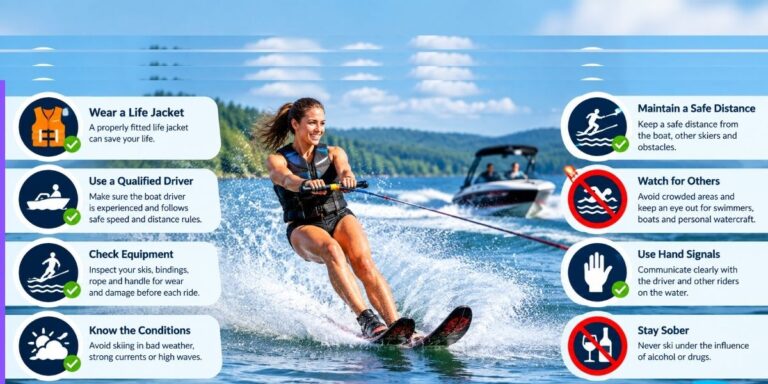
Water skiing is one of those sports where most accidents don’t come from bad luck — they come from skipping a basic precaution that everyone knows about but doesn’t always bother with. The right gear, a dedicated spotter, and a few solid habits from both the skier and the driver cover the vast majority of what actually causes injuries out on the water.
Get the Gear Right Before You Even Start
A properly fitted, Coast Guard-approved (or your country’s equivalent) life jacket isn’t optional — it needs to actually fit snugly, not just be present in the boat. Before heading out, take a minute to check your bindings, skis, and tow rope for fraying or loose parts; gear failure mid-run is entirely preventable with a quick inspection.
One rule that can’t be bent: never wrap the tow rope around your hands, wrists, or any part of your body. If the boat suddenly accelerates or you fall awkwardly, a wrapped rope can cause serious injury in a split second — always hold it loosely enough to let go instantly if needed.
What the Boat Driver and Spotter Need to Do
Skiing safely is really a three-person job — skier, driver, and spotter — and skipping the spotter is one of the more common mistakes. A dedicated spotter’s only job is watching the skier continuously, so the driver can focus entirely on the water ahead. Trying to do both jobs at once is how skiers end up unnoticed after a fall.
Agree on hand signals before you start moving — faster, slower, stop, and head back to the dock — so there’s no confusion or guessing once you’re underway and can’t easily shout over engine noise.
Propeller safety deserves its own mention: always cut the engine completely before letting a fallen skier swim up to the boat or climb back in at the stern. A spinning propeller near someone in the water is one of the most serious and entirely preventable risks in the sport.
And obviously: nobody should be driving the boat, or skiing, under the influence of alcohol or drugs. Reaction time and judgment both matter enormously here, and neither holds up well when impaired.
What Skiers Should Actually Do
Fall smart, not stiff. If you’re going down, try to fall backward or to the side rather than pitching forward, and at higher speeds, tuck your chin and pull your limbs in close rather than letting them flail — that reduces the chance of a hard, awkward impact with the water.
Signal that you’re okay after a fall. Stay where you are, and either hold a ski straight up or clasp your hands over your head. This does two things: it tells the boat you’re fine, and it makes you visible to other boats in the area who might not otherwise notice a person in the water.
Know your actual limits. Stick to skiing in daylight, avoid crowded or restricted zones where boat traffic is heavy, and when you’re slowing down to land, run parallel to shore rather than heading straight toward it.
Watch the weather, not just the water. If lightning, thunder, or strong winds are moving in, get off the water. Conditions that seem fine can shift fast, and open water is one of the worst places to be caught in a storm.
