

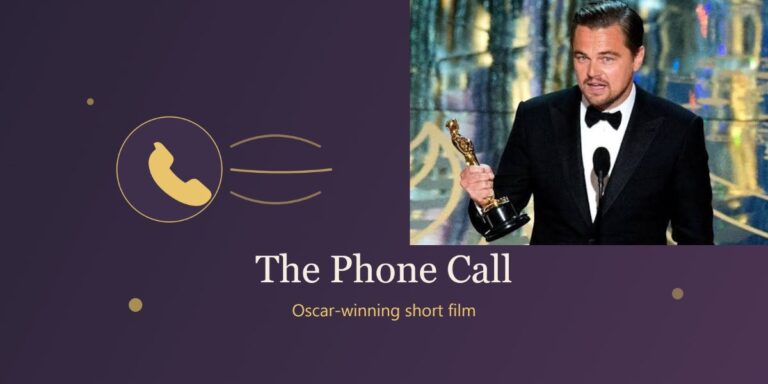
Short films rarely get the attention they deserve, but every so often one comes along that lingers in your mind long after the credits roll. The Phone Call (2013), directed by Mat Kirkby, is exactly that kind of film. In just over 20 minutes, it delivers a story so emotionally powerful that it went on to win the Academy Award for Best Live Action Short Film at the 87th Oscars. If you haven’t seen it yet, here’s everything you need to know about why this small British production made such a big impact.
1. What Is The Phone Call Short Film About?
At its core, The Phone Call is a two-hander drama about connection, grief, and empathy. The film follows Heather, a quiet, unassuming woman who works at a helpline call centre. Her day takes an unexpected turn when she answers a call from a man who is struggling with something far more serious than the usual queries she handles. What unfolds is an intimate, real-time conversation that changes both of their lives.
The entire film takes place almost like a single scene — a phone call — yet it manages to build a complete emotional arc without ever showing the two lead characters in the same physical space.
2. The Story and Plot of The Phone Call
The story begins simply enough: Heather picks up a call from a man named Stanley, an elderly widower who has recently lost his wife of many years. As the conversation progresses, it becomes clear that Stanley isn’t calling for ordinary advice — he’s reached a breaking point after losing the person he loved most.
Heather, trained to stay calm and supportive, slowly realizes the gravity of the situation. Without ever leaving her desk, she has to find a way to keep Stanley talking, understand where he is, and try to help him — all while wrestling with her own helplessness at not being able to physically reach him.
The brilliance of the plot lies in its restraint. There are no dramatic flashbacks or unnecessary subplots — just two voices, a phone line, and the weight of a life hanging in the balance.
3. Why The Phone Call Is Worth Watching
In an age of fast-paced content, The Phone Call proves that a story doesn’t need elaborate settings or a big budget to be unforgettable. It’s worth watching because:
- It’s a masterclass in minimalist storytelling.
- The performances are raw and completely believable.
- It tackles a heavy subject with sensitivity rather than melodrama.
- It respects the audience’s intelligence, trusting silence and pacing as much as dialogue.
For anyone who loves character-driven drama, this short film is a must-watch.
4. Sally Hawkins Delivers a Powerful Performance
Sally Hawkins, known for her Oscar-nominated and Golden Globe-winning work, plays Heather with remarkable subtlety. Because most of the film rests on her reactions — her voice, her expressions, her body language — Hawkins had to carry the emotional weight of the story almost single-handedly.
She shifts effortlessly between professional composure and quiet panic, letting the audience feel Heather’s helplessness without a single word of exposition. It’s the kind of performance that reminds you why she’s considered one of the finest actresses of her generation.
5. Jim Broadbent and the Supporting Performance
Jim Broadbent, an Academy Award winner himself, voices Stanley, the man on the other end of the line. Since his character is never seen on screen, Broadbent had to rely entirely on vocal performance to convey decades of love, loss, and despair.
His voice cracks at just the right moments, carrying decades of shared memory in a handful of lines. Alongside Hawkins, the supporting cast — including Edward Hogg and Prunella Scales — adds further depth to the world around Heather’s call centre desk, even in their brief appearances.
6. What Makes The Phone Call So Emotional?
The emotional power of The Phone Call comes from its honesty. It doesn’t manipulate the audience with dramatic music cues or forced sentimentality. Instead, it lets a very human, very real conversation play out almost in real time.
Because the audience never sees Stanley, our imagination fills in the blanks — his home, his loneliness, the photograph of his late wife he might be looking at. That distance, paradoxically, makes the emotional impact even stronger.
7. How the Film Builds Tension in Just 22 Minutes
Despite its short runtime, the film builds tension methodically:
- It starts with an ordinary, almost mundane call centre setting.
- The tone shifts gradually as Heather senses something is wrong.
- The stakes escalate in real time, mirroring the urgency Heather feels.
- The camera stays close on Heather’s face, making the audience experience her anxiety directly.
This slow-burn structure means that by the film’s midpoint, viewers are just as invested and anxious as the character on screen.
8. The Awards and Recognition Behind The Phone Call
The Phone Call‘s achievements speak for themselves. The film premiered at the 2014 Tribeca Film Festival, where it won Best Narrative Short. It went on to earn a nomination — and ultimately the win — for Best Live Action Short Film at the 87th Academy Awards in 2015. It also picked up recognition at other festivals, including an audience award at the Short Shorts & Asia Film Festival in Japan.
This string of accolades cemented its place as one of the most celebrated short films of its era.
9. Where to Watch The Phone Call Short Film
The Phone Call is available on several platforms, including Amazon Prime Video and Vimeo On Demand, where it’s often listed alongside other acclaimed short films. It has also been made available on YouTube in official uploads. Availability can vary by region, so it’s worth checking your preferred streaming platform.
10. Other Oscar-Winning Short Films to Watch
If The Phone Call leaves you wanting more, here are a few other acclaimed short films worth exploring:
- The Silent Child – a moving story about a deaf child and her social worker.
- An Irish Goodbye – a bittersweet, warm story about two brothers.
- Skin – a tense drama exploring racism and its consequences.
- Two Distant Strangers – a genre-bending short tackling systemic injustice.
- The Neighbors’ Window – a heartfelt look at connection between strangers.
These films, much like The Phone Call, prove that short-form storytelling can be just as impactful as feature films.
11. Frequently Asked Questions About Oscar-Winning Short Films
What is the most award-winning short film?
This varies depending on category and year, but films like The Phone Call, The Silent Child, and Skin are among the most decorated in the Best Live Action Short category, collecting festival wins before their Oscar recognition.
What is the shortest short film to win an Oscar?
Several Oscar-winning shorts run under 15 minutes, though exact records shift year to year. Runtimes for eligible short films typically range from a few minutes to 40 minutes.
Which short films have won an Oscar for Best Live Action Short Film?
Winners include The Phone Call (2015), Stutterer (2016), The Silent Child (2018), Skin (2019), The Neighbors’ Window (2020), and Two Distant Strangers (2021), among many others across the years.
How can you watch Oscar-nominated short films?
Many are available on streaming platforms like Amazon Prime Video, YouTube, and Vimeo On Demand. Some years, ShortsTV also compiles nominated shorts into theatrical and digital collections.
What are the three Oscar short-film categories?
The Academy Awards recognize three short film categories: Best Live Action Short Film, Best Animated Short Film, and Best Documentary Short Film.
Note: since The Phone Call deals with themes of grief and suicidal crisis, this article discusses that subject matter in a factual, film-review context. If you or someone you know is going through something similar, it’s worth reaching out to a mental health professional or a crisis helpline — happy to help you find resources if that would be useful.
