

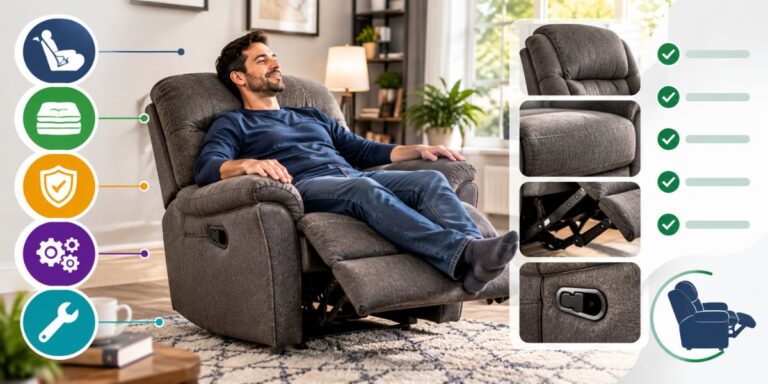
Buying a recliner sounds simple until you’re standing in a showroom trying five of them and somehow none feel quite right. The truth is most of that comes down to fit — a recliner that’s perfect for your neighbor might be genuinely uncomfortable for you, purely based on body size. Here’s what actually matters before you buy.
Getting the Fit Right for Your Body
This is where most people go wrong, and it’s the first thing to sort out. Your feet should sit flat on the floor with your knees bending at roughly a 90-degree angle — if you’re dangling or your knees are jammed up too high, the seat height is wrong for you. The seat depth matters just as much: the cushion should reach the back of your knees without a gap, and your hips need to sit all the way back against the chair, not perched near the front.
Back height is easy to overlook until you actually recline. When you lean back, does the top of the chair support your head and neck, or does your neck just hang off the edge? That’s the difference between an all-day-comfortable chair and one you regret after twenty minutes.
Most brands sort recliners into size tiers — petite, medium, large, tall — and it’s worth actually matching your height to the right tier instead of assuming “one size fits most.” It genuinely doesn’t.
Support Matters More Than Plushness
It’s tempting to sink into the softest, most pillowy recliner in the store, but that’s often the wrong call long-term. Ultra-plush foam feels amazing on day one and sags noticeably within a few months. High-density or layered foam holds its shape far longer, even if it feels slightly firmer when you first sit down.
Lumbar support should stay firm against your lower back through the full range of recline angles, not just when you’re sitting upright. And if back pain is part of why you’re shopping, look into zero-gravity positioning — it lifts your legs above heart level and takes real pressure off your lower back, which is a genuinely different feeling than a standard recline.
How the Mechanism Actually Works
There are a few different systems, and they suit different people:
- Power recline — smooth, button-operated, no wrestling with a handle. Especially worth it for anyone with limited hand strength or grip issues.
- Manual/lever — the classic pull-handle setup. Reliable, no batteries or cords involved, just a bit more physical effort.
- Pushback — you recline just by leaning your body weight back. No visible mechanism, cleaner look, but less adjustability.
- Motion base — rockers and gliders are great for nurseries or general soothing motion; swivel bases make sense in multi-use rooms where you want to turn toward the TV, a window, or a conversation without getting up.
Don’t Skip the Build Quality
A recliner is a mechanical piece of furniture, and cheap mechanisms show it fast — squeaking, wobbling, sticking when you try to recline. Look for a solid hardwood or reinforced metal frame underneath the upholstery, and a heavy-gauge steel track system for the recline mechanism itself. If you can, actually test the recline in the store rather than trusting a spec sheet.
Fabric and Fit for Your Space
Leather holds up well, wipes clean easily, and ages into a classic look — but it runs warmer against skin than fabric. Performance or “smart” fabrics are worth a serious look if you’ve got kids or pets, since they’re built to resist stains without needing leather’s higher price tag.
Room layout matters too. Standard recliners need real clearance behind them to fully recline, which can eat up more space than people expect. Wall-hugger recliners solve that — they only need a few inches of clearance from the wall, which makes them a smart pick for smaller rooms or tight furniture arrangements.
The Extras Worth Considering
Once the fundamentals are covered, a few add-ons are worth thinking about depending on how you’ll use the chair: a power headrest or adjustable lumbar support for extra customization, built-in USB charging if you’ll be using it as your main reading or screen-time spot, or lift-chair assistance if mobility is a concern for whoever’s using it.
