

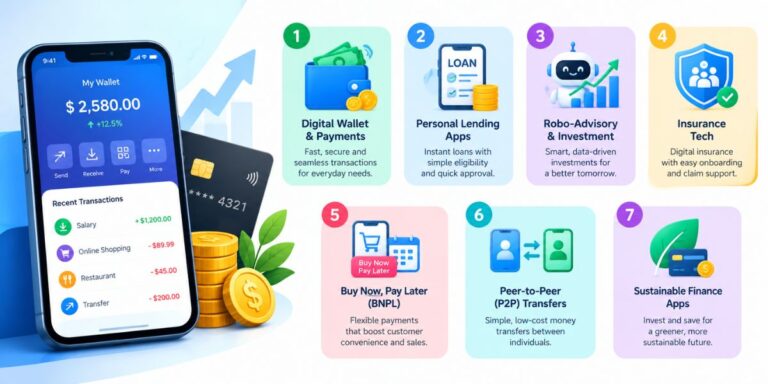
Building a successful fintech app today isn’t about chasing the next flashy trend — it’s about finding a genuine gap where people or businesses are stuck using clunky, outdated, or manual processes, and building something that removes that friction. Here are seven fintech app concepts that hit that mark, each targeting a specific audience with a clear path to revenue.
1. AI-Powered Cash Flow Copilot for Small Businesses
Most small business owners and freelancers don’t struggle because they lack accounting software — they struggle because that software only tells them what already happened. An AI-driven cash flow copilot flips that around, predicting upcoming shortfalls before they hit and automatically suggesting how to time payments or draw on working capital. This kind of forward-looking insight is something traditional bookkeeping tools simply don’t offer, which makes it a strong candidate for a subscription model in the $29–$99/month range.
2. Micro B2B Invoice and Payment Gateway
Small B2B service providers often deal with clunky, manual invoicing and payout processes, especially when working across regions or currencies. A streamlined gateway that handles multi-rail payouts and reconciles invoices automatically removes a genuine pain point. Because this model runs on transaction volume rather than subscriptions, a fee structure around 1.2% plus a flat charge per transaction scales naturally as usage grows.
3. Embedded Fractional Asset Platform
Retail savers and small businesses increasingly want a way to earn yield on idle cash without navigating complicated investment platforms. A fintech app offering fractional or tokenized access to short-term assets like T-bills gives users an easy on-ramp to better returns than a standard savings account. Revenue here typically comes from an assets-under-management fee, generally in the 0.25–0.5% range.
4. AI-Driven Alternative Credit Scoring
Millions of people and small businesses remain “thin-file” or unbanked, meaning traditional credit scoring simply doesn’t work for them. An app that scores creditworthiness using alternative data — things like utility payments, transaction history, or mobile usage patterns — opens up lending opportunities that conventional credit bureaus miss. This model works well as an API service, charging lenders and microfinance institutions per query.
5. Automated Regulatory and Tax Compliance (RegTech)
Sales tax and VAT compliance is one of the more tedious, error-prone parts of running a small business or e-commerce store, especially across multiple jurisdictions. A RegTech app that tracks obligations in real time and prepares filings automatically saves business owners hours of manual work and reduces costly mistakes. A straightforward monthly subscription fits this model well.
6. Collaborative B2B Expense and Spend Controller
Remote and hybrid teams need better tools to manage spending across multiple employees without losing control or visibility. An app offering virtual card issuing, spending limit guardrails, and automatic receipt capture through OCR gives finance teams the oversight they need without slowing employees down. Revenue can come from a combination of interchange fees and a SaaS subscription layer.
7. Green Spend and Carbon Tracker
A growing segment of consumers and small businesses want visibility into the environmental impact of their spending, and a fintech app that links directly to bank accounts to track this — while suggesting eco-friendly vendor alternatives or offset options — taps into that demand. Partner and affiliate fees from featured sustainable vendors offer a workable monetization path.
How to Actually Build One of These
Getting from idea to working product generally follows three phases. First comes validation and MVP development, typically over about 12 weeks, focused on nailing one tight workflow rather than trying to build everything at once — expect a baseline cost somewhere between $25,000 and $50,000 for this stage, using a stack like React Native or Flutter on the front end and Node.js or Python on the back end, paired with open banking APIs.
From there, compliance and security become the priority: encryption both at rest and in transit, role-based access controls, and integration with KYC/AML verification vendors. If the app touches card payments, PCI-DSS compliance becomes non-negotiable too.
Finally, distribution and unit economics take center stage from month six onward. Partnering with local accounting firms or B2B software marketplaces tends to work better for these apps than pure consumer marketing. The number to watch closely is customer acquisition cost relative to lifetime value — B2B fintech apps with thin margins can be sunk quickly by high churn if CAC creeps above roughly three times LTV.
A Closer Look: Why the Cash Flow Copilot Stands Out
Among these seven, the SME cash flow copilot has a particularly compelling case. Traditional accounting tools are backward-looking by design, but businesses genuinely need forward-looking liquidity alerts to avoid getting caught off guard. The main operational risk is data ingestion — legacy regional bank portals and APIs can be unreliable, which adds ongoing support overhead.
To put rough numbers on it: with 1,000 active SME users paying an average of $49/month, that’s about $49,000 in monthly revenue. Subtract roughly $6,000 in data, cloud, and AI API costs and another $5,000 for support and compliance, and you’re left with a gross margin around 77%, or roughly $38,000 per month. That’s a healthy margin profile for an early-stage fintech product.
