

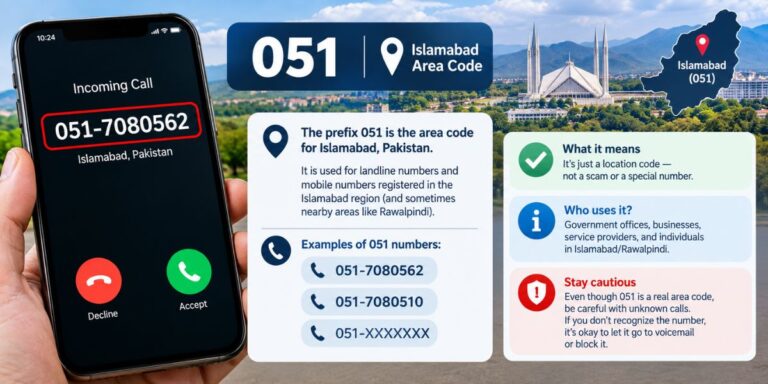
If you’ve been getting calls from numbers starting with 051 — including ones like 051-7080562 or 051-7080510 — the first thing worth knowing is what that prefix actually represents. 051 is the landline area code for Islamabad and Rawalpindi, Pakistan’s twin cities. That alone doesn’t tell you whether a call is legitimate or not, since a huge range of callers — from banks to government offices to scammers — can all technically dial out from a number in that range.
Why You Might Be Getting These Calls
Official and business lines. A lot of government departments, corporate head offices, and private companies based in Islamabad or Rawalpindi run their landlines through this prefix. If you’ve ever applied for something, opened an account, or interacted with a company headquartered in the twin cities, a follow-up call from a 051 number isn’t automatically suspicious.
Automated and financial reminders. Banks and microfinance or loan services — JazzCash ReadyCash reminders being one commonly mentioned example — also use 051 lines to reach customers about payments, reminders, or account notices. These are usually legitimate, though it’s still worth verifying independently rather than assuming.
Spam and scam attempts. This is where a lot of the complaints come from. Plenty of people have reported unsolicited calls from random 051 numbers pushing promotional offers or, more concerning, trying to extract personal or banking information under some pretext. The prefix itself doesn’t cause this — it just means scammers dialing from Islamabad/Rawalpindi-based lines show up with a 051 number like anyone else.
What This Means for the Specific Numbers You Mentioned
Without more context on what these particular numbers said or asked for, there’s no way to definitively label 051-7080562 or 051-7080510 as scams versus legitimate business or financial callers — plenty of both types operate under this same prefix. That said, the same basic caution applies regardless: if either number asked for personal details, PINs, or codes, or tried to pressure you into a payment, treat that as a red flag no matter how official the caller sounded.
Staying Safe Either Way
- Never give out your PIN, OTP, CNIC number, or banking details over an unsolicited call, even if the caller claims to represent a bank, mobile wallet service, or government office. Legitimate organizations don’t ask for this information this way.
- Don’t call back a number that rings once and disconnects. If it’s important, they’ll call again or leave another way to reach them.
- If you’re unsure whether a call is genuine, hang up and contact the company directly through their official customer service number, not a number the caller gave you.
- Block persistent numbers through your phone’s call settings if you keep getting repeat calls with no clear legitimate purpose.
- If a call already led to you sharing sensitive information, contact your bank or mobile wallet provider immediately to secure the account.
If you run into more of these numbers and want a second opinion, share the exact digits — checking whether others have reported the same number as suspicious is a reasonable first step before deciding how seriously to treat it.
