

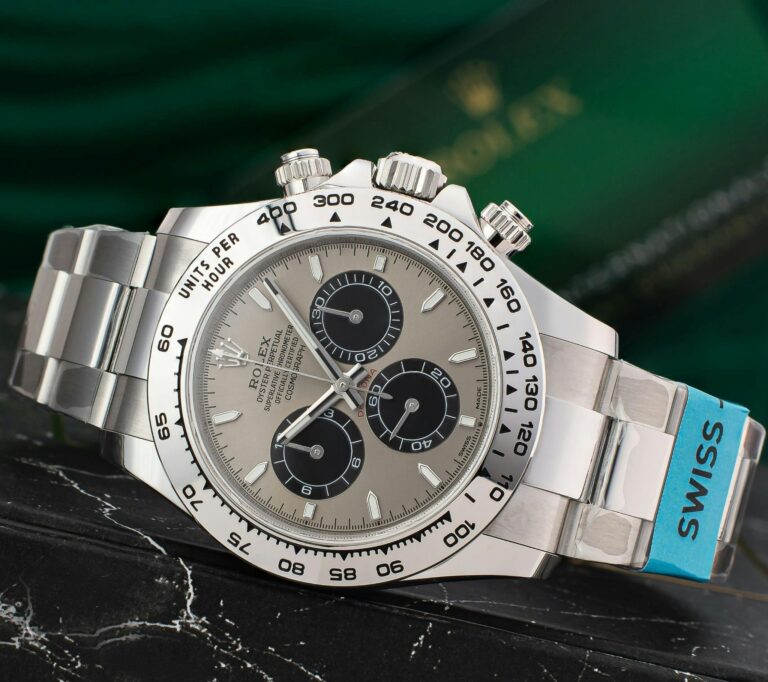
The Rolex Daytona is not only a high-end timepiece, but it is a standard of mechanical accuracy and engineering perfection. This iconic-designed timepiece with its perfect chronograph functions has won over both watch lovers and watch professionals. Firstly, it was intended to be used in the motorsport timing, which provides unparalleled accuracy even in the extreme conditions, thus becoming a symbol of performance and prestige.
The Rolex Daytona has a lot more than a pretty face to it. All the parts are carefully designed and assembled so as to measure time precisely. What makes it stand out among the ordinary chronographs is that it can measure the time that has elapsed with superb accuracy. During decades, Rolex has perfected this model, integrating the old art with the new technology in order to sustain the industry-leading standards.
Evolution of the Rolex Cosmograph Daytona
Rolex Cosmograph Daytona has gone through considerable development since it was first launched in 1963. It was designed originally to be used by professional racing drivers and had a tachometer bezel inside to compute speed across a certain distance. Gradually Rolex improved its design and internal functioning and turned it into one of the most demanded chronographs in the world.
Previously, it has been based on modified external movements, but Rolex has finally created its own in-house caliber to be sure of more control over accuracy and dependability. This shift was a turning point in the history of the Daytona. The models of today are based on decades of research and innovation, as well as engineering skills, and are much more accurate, durable, and efficient in their performance than the previous models.
Core Components of a Chronograph Mechanism
A chronograph is a watch with a stopwatch built in, and its mechanism has to work by a complicated set of gears, levers, and springs. Rolex Daytona has a chronograph mechanism that enables individuals to start, stop and reset time keeping processes without disrupting the primary time keeping mechanism. This needs a complex mechanical coordination.
The major parts are the chronograph wheel, coupling system and reset hammer. All the parts should correspond with each other to operate smoothly. These components in the Daytona are designed with the utmost accuracy, minimizing friction and wear through use. This not only enhances accuracy but also ensures long-term reliability, even with frequent use of the chronograph functions.
The Caliber Movement: Heart of Precision
The Rolex Daytona is known to have its in-house movement, which is said to be the heart of its accuracy. In the year 2000, the Caliber 4130 was launched which transformed the performance of the watch by making the chronograph very easy and efficient. It reduces loss of energy and increases reliability as it has fewer components as compared to the traditional chronograph movements.
This movement has a self-winding engine that is driven by a rotor, and uses the energy of the movement of the wrist. It also has a power reserve of about 72 hours so that it maintains the same performance even when not worn on a daily basis. Its design not only focuses on precision but also durability, which contributes to its being one of the toughest chronograph movements to have ever been developed by Rolex.
Vertical Clutch and Column Wheel System
The Rolex Daytona has one of the most distinguishing engineering features in the form of a vertical clutch. The vertical clutch, unlike the conventional horizontal clutches, also enables the chronograph to be smoothly engaged without the second hand leaping. This guarantees the accuracy of timing since the very moment the chronograph is started, and this is essential in professional applications.
The column wheel system also improves functionality by regulating the start, stop and reset. The column wheel is known to be reliable and ease of operation and this will guarantee that every functionality is performed accurately. All these systems ensure a flawless user experience and this reflects the desire by Rolex to build on the engineering excellence and mechanical perfection.
Materials and Durability Engineering
Rolex is very keen on the materials used in the construction of the Daytona. The watch is made of some of the best metals including Oystersteel, gold, and platinum, all of which are chosen due to their durability and corrosiveness. Such materials make sure that the watch can withstand even in the most hostile environment, being still appealing to the eye.
The internal parts are also composed of high-tech materials that minimize friction and wear in addition to the external parts. An example is the paramagnetic hairspring employed by Rolex, which does not interfere with magnetic fields, which is a major source of mechanical watch inaccuracy. This concern with material science is important to the long-term accuracy and dependability of the Daytona.
Accuracy, Testing, and Certification Standards
The Rolex Daytona is all about precision and it is obtained by means of strict tests and certifications. All watches are subjected to a rigorous quality testing to make sure that they pass the strict standards of Rolex. Internal testing of the brand exceeds industry standards as each timepiece is tested to be functioning perfectly in the real-life setting.
Rolex watches are certified as Superlative Chronometers, a designation that guarantees exceptional accuracy. This implies that the watch is tested in terms of accuracy, power efficiency, waterproofing and the self winding efficiency. These high levels of standards guarantee the Daytona to provide consistent performance and is a reliable instrument to both professionals and enthusiasts.
Role of Innovation in Timekeeping Precision
The success of Rolex Daytona has always been fuelled by innovation. Since the invention of in house movements to the utilization of new materials Rolex keeps on pushing the limits of watchmaking. Such innovations are not only concerned with the performance but also long-term reliability and user satisfaction.
Modern technology combined with the ancient artisanship enables Rolex to attain unrivalled precision. As an example, computer aided design and highly developed manufacturing techniques are used so that every component is manufactured with the precision of a microscope. It is this innovation coupled with expertise that has maintained the Daytona as the top of the chronograph engineering.
Why the Rolex Daytona Stands Above Competitors
The perfection in Rolex Daytona is its ability to combine design, functionality, and engineering excellence. Although a lot of the luxury watches have the chronograph feature, not many have the same degree of accuracy and consistency as the Daytona. Its self-propelled motion, superior clutch mechanism and high-grade testing specifications distinguish it among the rivals.
Additionally, the legacy and reputation of the Daytona make it an attraction. It is not merely a watch but a representation of success and artistry. It is not only appreciated by the collectors and enthusiasts due to its performance but also because of its historical importance. This technical perfection and cultural influence makes the Daytona one of the most popular watches in the world.
Conclusion
The Rolex Daytona has an engineering behind the precision of its chronographs which is a testament to Rolex commitment to excellence. Its high-quality materials, tight testing criteria, advanced movement, and novel clutch system, all its features are developed to provide the best possible performance. It is the ideal illustration of how ancient craftsmanship and latest technology could join in order to produce something really remarkable. To any person who wants a timepiece that is accurate, strong and poses prestige, Rolex Daytona is an unmatched option. Its legacy and constant innovations guarantee the fact that it will be the standard of the luxury chronographs in the generations to come.
