

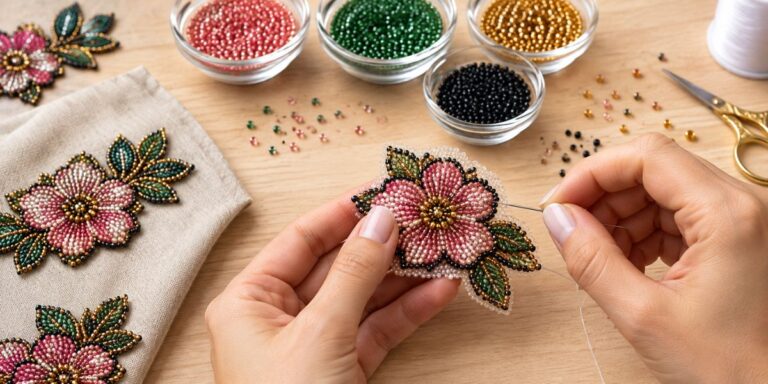
Beaded appliqué on a peyote base is a beautiful beadwork technique that combines the structured look of peyote stitch with decorative appliqué elements. It can be used to create pendants, bracelets, earrings, brooches, decorative patches, and other handmade jewelry pieces.
The technique may look complicated at first, but once you understand how the peyote base is built and how the appliqué is attached, it becomes much easier to work with. The key is keeping your tension consistent and planning the design before adding the decorative elements.
What Is a Peyote Base?
A peyote base is a flat piece of beadwork created using the peyote stitch. In this stitch, beads are arranged in an offset pattern rather than directly beside one another.
The result is a flexible but relatively firm beaded surface that works well as a foundation for additional decoration.
Depending on the project, you can make the peyote base narrow, wide, round, oval, or in another shape. The size of the base usually depends on the final design you want to create.
What Is Beaded Appliqué?
Beaded appliqué involves attaching decorative beads, motifs, shapes, or beadwork components onto a separate surface or foundation.
When used with a peyote base, the appliqué becomes part of the overall beadwork design. You can create flowers, leaves, geometric patterns, initials, borders, or abstract motifs.
This makes the technique particularly useful when you want to add dimension and visual detail to an otherwise simple peyote-stitched piece.
Materials You Will Need
Before starting, gather all the materials you need. Using beads that are reasonably consistent in size will make the finished piece look cleaner.
Common supplies include:
- Seed beads for the peyote base
- Smaller or contrasting beads for the appliqué
- Beading needle
- Strong beading thread
- Scissors
- Bead mat or soft work surface
- A clasp or findings if making jewelry
- Optional accent beads for additional decoration
You can use the same bead color throughout the project or combine several colors to create contrast between the base and appliqué.
How to Make a Beaded Appliqué on a Peyote Base
1. Plan Your Design
Start by deciding what you want the finished piece to look like.
Sketching the pattern on paper or arranging beads on your work surface can help you visualize the colors, shape, and placement.
Think about the size of the peyote base and make sure there is enough space for the appliqué.
2. Create the Peyote Base
Begin by making a flat peyote-stitched foundation.
String the required number of beads for your first row, depending on the size and type of peyote stitch you are using. Continue adding beads according to the peyote pattern until the base reaches the desired length and width.
Try to maintain even thread tension throughout the process. If the tension is too loose, the base can become uneven. If it is too tight, the beadwork may curl.
3. Check the Shape
Before attaching the appliqué, lay the peyote base flat and check its shape.
The edges should look reasonably even, and there should not be large gaps between beads. If you notice uneven tension, it is usually easier to correct it before continuing with the decorative work.
4. Prepare the Appliqué
Now create or prepare the decorative element that will sit on top of the peyote base.
For example, you could make a small beaded flower, leaf, star, geometric motif, or another decorative shape.
The appliqué should be proportional to the peyote base. A very large motif can overwhelm a narrow base, while a tiny motif may not provide enough visual interest.
5. Position the Appliqué
Place the decorative piece on the peyote base and decide exactly where you want it.
For symmetrical designs, you can mark the center of the base before attaching the appliqué. This can help prevent the design from becoming slightly off-center.
Take a moment to check the placement from different angles before stitching it down.
6. Attach the Appliqué
Thread your needle with a suitable length of beading thread and bring the needle through the peyote base from the underside.
Pass the needle through selected beads in the appliqué and then back through the base.
Continue stitching around the appliqué until it is securely attached.
Avoid pulling the thread excessively. The goal is to hold the appliqué firmly against the peyote base without distorting the shape.
7. Reinforce the Design
Once the appliqué is attached, reinforce areas that may experience additional movement or pressure.
You can make extra passes through strategic beads, especially around corners, points, or larger decorative elements.
This step is particularly useful for jewelry that will be worn regularly.
8. Finish the Thread Securely
When the beadwork is complete, secure the thread carefully.
Pass the needle through several nearby beads, create secure knots where appropriate, and weave the remaining thread through the beadwork before trimming it.
A clean thread finish helps prevent the piece from coming apart during use.
Choosing Colors for Peyote Appliqué
Color selection can completely change the appearance of a beaded appliqué project.
A contrasting appliqué creates a bold design, while similar colors produce a more subtle and sophisticated appearance.
For example, a neutral peyote base can provide a good background for bright floral appliqué. Alternatively, metallic accent beads can be used to add highlights to a darker design.
If you are new to the technique, working with two or three colors can make it easier to see the stitch pattern.
Tips for Better Beaded Appliqué
Consistent tension is one of the most important parts of successful beadwork. Try to keep your thread tension even from the beginning to the end.
It is also helpful to use beads that are similar in size. Significant differences between individual beads can make the peyote base uneven and make the appliqué more difficult to attach.
Another useful tip is to avoid making the appliqué too heavy. A large number of beads placed on one small area can cause the peyote base to bend or lose its shape.
Common Mistakes to Avoid
One common mistake is starting the appliqué before the peyote base is properly shaped. If the foundation is uneven, the finished piece may also look uneven.
Another mistake is pulling the thread too tightly while attaching the appliqué. Excessive tension can cause the base to curl or pull the decorative element out of shape.
It is also important to check the thread path as you work. Accidentally crossing the thread through the wrong beads can make later stitches difficult.
Creative Ideas for Peyote-Based Appliqué
Once you understand the basic technique, there are many ways to experiment.
You can create a floral pendant with a small flower appliqué in the center. A geometric motif can work well for modern bracelets, while leaves and vines can create a more traditional appearance.
For special occasions, crystal or metallic accent beads can be incorporated into the appliqué. You can also combine different bead sizes to create subtle texture.
How to Make the Finished Piece More Durable
Durability depends largely on the quality of the thread, the consistency of the stitching, and how securely the appliqué is attached.
For wearable jewelry, reinforce the attachment points and avoid leaving long exposed sections of thread.
It is also a good idea to store finished beadwork away from sharp objects that could catch the thread.
Final Thoughts
Beaded appliqué on a peyote base is a versatile technique that allows you to combine structure with decoration. The peyote stitch provides a strong visual foundation, while the appliqué adds color, texture, and personality.
Once you become comfortable with consistent peyote stitching and secure attachment techniques, you can experiment with your own motifs and designs. From simple bracelets to detailed pendants and decorative pieces, this technique offers plenty of room for creativity.
Frequently Asked Questions
What is a peyote base in beadwork?
A peyote base is a flat foundation made using peyote stitch. It provides a structured surface for additional beadwork or decorative elements.
Can I use different bead sizes for the appliqué?
Yes. Different bead sizes can add texture and dimension, although it is best to use them carefully so the appliqué does not become too heavy.
Is peyote stitch difficult for beginners?
Peyote stitch can take a little practice, especially when learning thread direction and bead placement. Starting with a small project can make the technique easier to understand.
How do I keep my appliqué from moving?
Use multiple secure thread passes through both the appliqué and the peyote base. Keep the tension firm but avoid pulling so tightly that the base becomes distorted.
What can I make with a peyote appliqué?
You can use the technique for bracelets, earrings, pendants, brooches, decorative patches, ornaments, and many other beadwork projects.
