

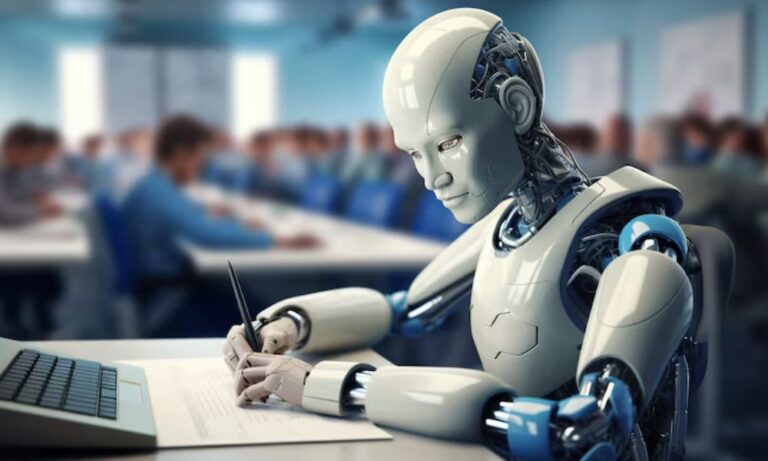
1. What Is an AI Test Taker and How Does It Work?
The term AI Test Taker describes artificial intelligence systems designed to answer exam-style questions. These questions might be multiple-choice, written responses, math problems, scientific explanations, or language tests. Instead of a human reading and thinking through the question, an AI system uses large databases, language models, and probability calculations to estimate the correct answer.
Modern AI tools, especially large language models, analyse patterns from millions of examples. When they receive a question, they identify keywords, compare them with their knowledge, and generate what they believe is the most logical answer. Unlike earlier programs that required strict rules, today’s AI learns from context, meaning it can understand tricky phrasing, long paragraphs, and problem-solving tasks.
An AI test taker doesn’t “understand” the exam like a human. It does not panic, study, or memorize. It processes data and predicts outcomes. This makes it powerful in structured tests, but imperfect in real-world reasoning.
2. Can AI Really Take Exams for You? The Truth vs The Hype
Online discussions sometimes make it sound like AI can sit a school test and pass easily. The reality is more complicated.
AI can perform very well on certain digital exams, especially multiple-choice questions that follow predictable rules. However, many official testing systems now use locked browsers, real-time proctors, webcam monitoring, biometric verification, and plagiarism detection. These tools exist because institutions want academic honesty.
So yes — AI can answer questions, but it cannot legally or ethically “take” your exam on your behalf. Schools and universities treat that as cheating. The useful way to see AI is as a study partner, not a secret exam taker.
The hype online often ignores consequences such as grade cancellation, academic penalties, or being banned from a program. Responsible use is about understanding, revising, and improving—not hiding behind a tool.
3. Top AI Tools Designed for Online Test Assistance
There are several AI-powered platforms designed to support learning. Some people refer to them as “test takers,” but their official function is tutoring. Examples include:
- AI chatbots that solve math or explain science
- Quiz generation apps that help students practice questions
- Adaptive learning platforms that identify weak areas
- Language-learning systems that score grammar or essays
- Exam simulators that predict question difficulty
These tools don’t “sit exams.” They prepare users for better performance. Many students now revise with AI because it gives instant steps, examples, and summaries.
In professional fields — law, finance, engineering — AI study tools help candidates practice thousands of sample questions. Instead of memorizing, students learn patterns, vocabulary, and logic.
4. Are AI Test Takers Accurate or Just Lucky Guessers?
Accuracy depends on the subject.
AI performs very well in:
- structured multiple-choice questions
- vocabulary tests
- reading comprehension
- math logic
- coding syntax
It performs poorly in:
- questions requiring original thought
- subjective marking
- personal experience essays
- emotional interpretation
- creative storytelling
In scientific or mathematical environments, AI uses formulas and pattern predictions. The confidence level may be high, but it can still get answers wrong when a problem requires something outside its training data.
Sometimes AI appears accurate simply because it is good at guessing patterns. If a question looks similar to one in its database, it predicts correctly. If the structure is unfamiliar, accuracy drops.
So the answer: AI is smart, but not perfect, and its confidence can be misleading.
5. Why Schools and Universities Are Worried About AI in Exams
Education systems exist to measure what a student truly understands. When AI produces answers, the result might not represent the student’s learning.
Institutions worry about:
- unfair advantage
- weak understanding beyond the test
- students skipping research
- loss of academic honesty
- graduates unprepared for jobs
Many universities now include oral interviews, handwritten work, project-based assessments, and supervised exams to avoid undisclosed AI participation. They want to measure comprehension, not shortcuts.
There is also a market pressure. Employers expect graduates to solve problems themselves. If a qualification becomes meaningless, the industry loses trust.
6. AI Test Taker vs AI Study Helper — What’s the Difference?
A true AI test taker implies performing the test secretly for someone. This is associated with unethical behaviour and academic fraud.
An AI study helper does something different:
- explains concepts
- breaks down problems
- gives examples
- offers practice quizzes
- summarizes chapters
- supports revision
This difference matters. Responsible students use AI to learn more deeply, not bypass work. Instead of hiding from teachers, they use AI like a textbook.
AI is a tool — not a replacement for skill.
7. How AI Identifies Correct Answers in Multiple-Choice Tests
Multiple-choice exams are the easiest domain for AI. The process usually follows these steps:
- Identify the main topic or specification of the question
- Retrieve related facts or relationships
- Eliminate choices that contradict known information
- Choose the highest-probability remaining answer
Sometimes AI also uses frequency analysis. For example, if many correct answers in a chapter relate to a particular rule, the AI may prioritise it.
However, good multiple-choice exams include distractors — answers that look correct but are wrong. Humans often catch emotional or logical clues better than AI. So even here, AI is strong but not unstoppable.
8. The Ethical Issues: Is Using an AI Test Taker Cheating?
Yes — using AI secretly during a scored exam is cheating.
Cheating destroys trust, reduces learning, and can carry punishments including grade cancellation or removal from a course.
However, pre-exam use — like study support — is not cheating. Many teachers encourage AI explanations because it helps weaker students catch up.
Ethics depends on transparency. If a teacher says:
- “Use AI for brainstorming only”
- “Do not use AI to generate final answers”
- “State which AI tools assisted your research”
then the responsibility is clear. Cheating with AI does not improve skill. It blocks progress.
9. Can AI Pass Medical, Law, or Engineering Exams?
Recent research shows that AI can score surprisingly well on several professional exams. AI models have passed sample questions from:
- medical licensing exams
- bar-style legal questions
- business management tests
- programming certifications
This does not mean AI can become a doctor or lawyer. Medical decisions require empathy, physical diagnosis, teamwork, and real-world judgment. Law requires negotiation, evidence handling, ethics, and case reasoning.
AI is powerful in theoretical problems and recall, not professional behaviour. If a patient presents symptoms that don’t match textbook descriptions, a human doctor must think beyond pattern recognition.
So yes — AI can solve test questions. But exams are not the world.
10. How EdTech Is Fighting Back Against AI Cheating Tools
EdTech companies are rapidly updating security. These include:
- identity verification
- webcam proctoring
- monitoring eye movement
- keystroke biometrics
- plagiarism detection
- AI-written content detectors
- human oral follow-ups after exams
Some platforms require students to:
- write on paper under supervision
- explain solutions verbally
- defend ideas live on camera
- submit drafts showing progress
Education is becoming more about process and reasoning, not just final answers.
Instead of eliminating AI, educators integrate it. Some universities now ask students:
“Use AI — but explain how you improved the answer and where the AI was wrong.”
This teaches critical thinking.
11. Will AI Replace Traditional Testing in the Future?
Testing is already evolving. Traditional memorization tests are declining because information is everywhere. Why memorize long tables when AI can retrieve them instantly?
Future assessment may include:
- real-life problem simulations
- teamwork projects
- ethical decision-making
- digital literacy
- open-resource tests where AI is allowed
Instead of banning AI, education may shift toward supervised creativity and verification skills. Students will be graded on how they think, not how well they cheat.
AI may eventually become like calculators in mathematics — once banned, now normal. But calculators did not remove the need for understanding; they just changed the skill requirement.
12. Is AI Better for Learning or Just Shortcutting Work?
AI can be used poorly or wisely. If used only to copy answers, it becomes a shortcut that blocks development. A student may pass a quiz but fail real-world responsibility.
Used properly, AI is a learning booster:
- It gives instant feedback instead of waiting for a teacher
- It provides multiple explanations for tough concepts
- It adapts to different learning speeds
- It offers examples, quizzes, and summaries
- It encourages curiosity
A responsible student views AI as a coach. They ask questions, compare answers, and build understanding.
Bad usage creates dependence; good usage builds skill.
Conclusion: AI Test Takers Are a Tool — Not a Replacement
Artificial intelligence has changed the academic landscape. It can solve questions, score well on structured exams, and support revision. But it lacks human reasoning, ethics, originality, and emotional judgment.
Education is about growth. AI should not steal learning—it should assist it.
The future is not about hiding AI from education; it is about teaching students to master it responsibly.
