

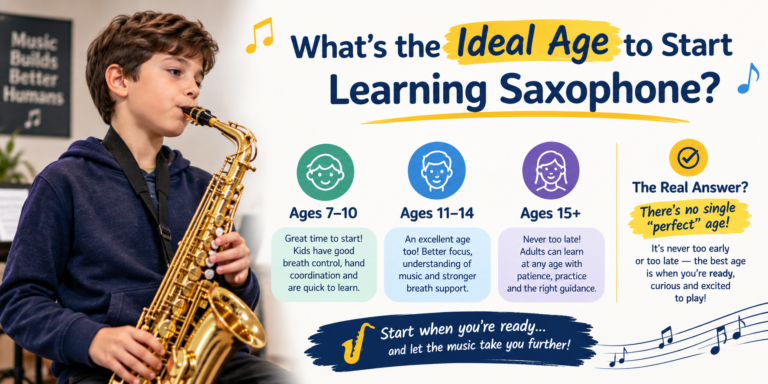
There’s no single perfect age to pick up a saxophone — but if you’re planning ahead for a child, most music teachers point to somewhere between 8 and 12 as the sweet spot. That said, the real answer depends less on a number and more on two practical things: hand size and lung capacity.
Why Younger Kids Usually Wait
Kids between 5 and 7 are often eager, but the saxophone itself works against them at that age. A full-size alto sax weighs around 5 kg once you factor in the neck strap and body angle, and that’s a lot for a small frame to support comfortably through a practice session. On top of that, the keys are spaced for adult-sized hands, so younger kids often end up straining just to cover the pearls properly.
Rather than waiting entirely, a lot of teachers suggest starting with something like a plastic recorder or basic percussion instead. It’s not a wasted detour — recorder playing builds the same breath control and finger dexterity that transfer directly once a kid is ready to move to sax. This is actually a pretty common recommendation among saxophone teachers and hobbyists online, not just a theoretical bridge instrument.
The 8–12 Window
By around age 8, most kids’ hands have grown enough to reach the keys without stretching uncomfortably, and their lung capacity has developed enough to sustain the steady airflow needed for full, controlled tones — especially the lower notes, which are the hardest to produce cleanly. This is why 8–10 tends to be cited as the earliest realistic starting point for a proper alto saxophone.
Once kids hit 11 or 12, there’s often an added bonus: middle and high school band programs kick in around this age, which gives lessons real structure and social momentum. At this stage, either alto or tenor sax becomes workable, depending on the student’s size and the instrument’s roughly 33-inch length.
What About Adults?
Here’s the good news for anyone thinking they’ve missed the window: there really isn’t an upper age limit. Adults — even well into their 50s and beyond — often progress faster in some respects than kids do, simply because they bring sharper focus and clearer motivation to practice. The tradeoff is that adult learners need to be more deliberate about pacing themselves, since embouchure fatigue (tiring of the facial muscles used to form your mouth around the mouthpiece) can build up quickly without careful practice habits. Starting with long tones and basic scales is the usual advice for building that endurance gradually.
The Physical Checklist, Regardless of Age
Before starting anyone on saxophone, it’s worth checking a few practical things:
- Hand size — fingers should comfortably reach and cover all the key pearls without straining
- Lung capacity — enough to hold steady airflow through a full tone, especially in lower registers
- Comfort with weight and posture — the instrument’s weight and the angle it sits at need to be manageable, even with strap support
Bottom Line
If you’re planning for a child, 8–12 is the realistic starting range, with recorder as a solid stepping stone for younger kids who are eager to start earlier. If you’re an adult wondering if it’s too late — it isn’t. Motivation and consistent practice matter more than age at that point.
