

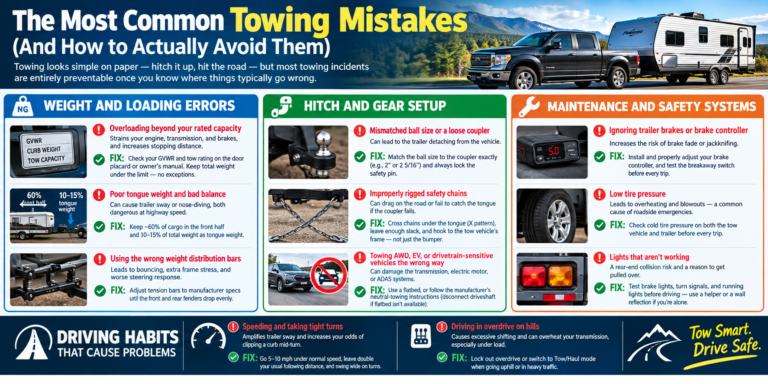
Towing looks simple on paper — hitch it up, hit the road — but most towing incidents are entirely preventable once you know where things typically go wrong. The two biggest culprits are exceeding weight limits and getting the load balance wrong, and both can lead to loss of control, dangerous trailer sway, or serious strain on your drivetrain. Here’s a breakdown of the mistakes that come up again and again, and what actually fixes them.
Weight and Loading Errors
Overloading beyond your rated capacity is the number one mistake people make, and it’s an easy one to make without realizing it. Going over your vehicle’s GVWR (gross vehicle weight rating) or your rated tow capacity puts real strain on your engine, transmission, and brakes, and it noticeably increases your stopping distance — which matters a lot when you’re already hauling extra mass. The fix is straightforward: check the weight rating on your driver’s door placard or in your owner’s manual, and keep your total combined weight under that number, no exceptions.
Poor tongue weight and bad balance cause a different problem — trailer sway or nose-diving, both of which are genuinely dangerous at highway speed. The general rule is to keep about 60% of your cargo weight in the front half of the trailer, and to aim for tongue weight sitting around 10-15% of the trailer’s total weight. Get that balance wrong in either direction and the trailer starts fighting the tow vehicle instead of following it.
Using the wrong weight distribution bars, or setting them up incorrectly, leads to bouncing, extra stress on the frame, and worse steering response than you’d expect. The fix here is adjusting the tension bars to the manufacturer’s specs until the front and rear fenders of the tow vehicle drop evenly — that even drop is basically the visual confirmation that the weight’s actually being distributed the way it’s supposed to be.
Hitch and Gear Setup
Mismatched ball size or a loose coupler is one of those mistakes that seems minor until the trailer actually detaches from the vehicle — which is exactly the risk here. Ball sizes like 2″ and 2 5/16″ look similar but aren’t interchangeable, so match the ball size to the coupler exactly, and always lock the safety pin once it’s connected.
Improperly rigged safety chains can mean the chains drag on the road or fail to catch the tongue if the coupler does fail. Cross them under the tongue in an X pattern, leave enough slack to make turns without binding, and hook them securely to the tow vehicle’s frame — not just to a bumper or something not rated for the load.
Towing modern AWD, EV, or drivetrain-sensitive vehicles the wrong way is a newer problem that didn’t really exist a decade ago, and it can cause serious damage to the transmission, the electric motor, or even the ADAS sensor systems on newer cars. These vehicles generally shouldn’t be flat-towed the way older vehicles could — use a flatbed, or disconnect the driveshaft and follow the manufacturer’s specific neutral-towing instructions if flatbed transport isn’t an option.
Maintenance and Safety Systems
Ignoring the trailer brakes or brake controller sets you up for brake fade or, worse, jackknifing under hard braking. Make sure your trailer brake controller is installed and properly adjusted, and get in the habit of testing the breakaway switch before every single trip — not just when you remember to.
Low tire pressure on either the tow vehicle or the trailer leads to overheating and, eventually, blowouts — which is one of the more common causes of roadside towing emergencies. Check cold tire pressure on both before you leave, every time, since pressure can shift meaningfully between trips.
Lights that aren’t working might not seem urgent, but it’s a real rear-end collision risk and a guaranteed way to get pulled over. Before driving, test your brake lights, turn signals, and running lights — grab a helper to confirm from behind, or check the reflection off a wall or garage door if you’re on your own.
Driving Habits That Cause Problems
Speeding and taking tight turns amplifies trailer sway and increases your odds of clipping a curb mid-turn. The fix is mostly about adjusting your driving style: go 5-10 mph under what feels normal, leave roughly double your usual following distance, and swing wide through turns to give the trailer room to track behind you properly.
Driving in overdrive on hills causes excessive shifting and can overheat your transmission, especially under load. Lock out overdrive, or switch into Tow/Haul mode if your vehicle has it, whenever you’re heading up an incline or dealing with heavy stop-and-go traffic.
