

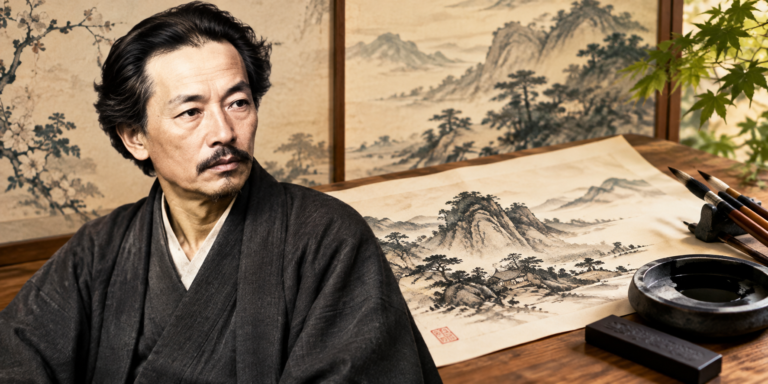
The name Tesseki is closely associated with Fujimoto Tesseki (1816–1863), a Japanese samurai, painter, calligrapher, and imperial loyalist who lived during the final years of the Edo period. Although his life was relatively short, Tesseki became known for both his artistic talent and his involvement in the political struggles that eventually helped bring the Tokugawa shogunate to an end.
His story is particularly interesting because it combines two very different worlds: traditional Japanese art and political rebellion. He was respected as a literati painter and calligrapher, while also becoming involved with the sonnō jōi movement, which called for loyalty to the emperor and opposition to foreign influence.
Who Was Fujimoto Tesseki?
Fujimoto Tesseki was born in 1816 in Okayama, Japan, during the Edo period. His birth name and personal history were connected to a samurai background, but his interests extended far beyond military life.
Tesseki developed a strong interest in literature, painting, calligraphy, and Chinese-inspired culture. He eventually became associated with the Nanga or Bunjinga tradition, a style of Japanese literati painting influenced heavily by Chinese scholar-artists.
Rather than concentrating only on realistic representation, this artistic tradition valued personal expression, brushwork, poetry, and scholarly knowledge.
Tesseki as a Japanese Painter
One of the most enduring parts of Tesseki’s legacy is his artwork.
His paintings often feature mountains, rivers, trees, flowers, birds, and other elements of the natural world. His landscapes reflect the influence of Chinese literati painting while retaining characteristics of Japanese Bunjinga.
Tesseki’s approach was not simply about reproducing what he saw. Literati artists often used landscapes as a way to express their personality, emotions, philosophy, and intellectual interests.
Today, examples of his work can be found in major art collections, including works associated with the Cleveland Museum of Art and other international institutions.
What Is Tesseki in Japanese?
The word tesseki (鉄石) has another meaning in Japanese that is separate from Fujimoto Tesseki‘s personal name.
The characters 鉄 and 石 mean “iron” and “stone.” Together, the term can be used metaphorically to describe something extremely firm, strong, or unshakable.
This meaning makes the word particularly appropriate when discussing determination or an unwavering state of mind.
The expression tesseki no shin (鉄石の心), for example, can convey the idea of a heart or mind that is as firm as iron and stone.
Therefore, when someone searches for “Tesseki,” they may be referring either to the Japanese word itself or to a historical figure such as Fujimoto Tesseki.
Tesseki and the Sonnō Jōi Movement
Fujimoto Tesseki lived at a time of major political and social change in Japan.
The Tokugawa shogunate had governed Japan for centuries, but by the middle of the 19th century its authority was being challenged. Foreign ships and Western powers were putting increasing pressure on Japan to open its borders.
This political environment contributed to the growth of the sonnō jōi movement.
The phrase is generally translated as “revere the emperor, expel the barbarians.” Supporters wanted to strengthen imperial authority and resist foreign influence.
Tesseki became increasingly involved in this political movement.
His Role in the Tenchūgumi
Tesseki is particularly remembered for his connection with the Tenchūgumi, a group of imperial loyalists who became involved in an armed uprising in 1863.
The group was made up largely of samurai and other supporters of the emperor. They sought to challenge the existing political order and encourage greater imperial authority.
Tesseki became one of the group’s leaders.
The Tenchūgumi rebellion took place in the region of Yamato, where the group attempted to establish a political base and challenge supporters of the shogunate.
However, the rebellion was ultimately unsuccessful.
How Did Fujimoto Tesseki Die?
Fujimoto Tesseki died in 1863, during the violent political conflicts surrounding the Tenchūgumi uprising.
His death came only a few years before the Meiji Restoration of 1868, which dramatically changed Japan’s political system and ended the Tokugawa shogunate.
Although Tesseki did not live to see the Meiji Restoration, his political beliefs were closely connected to the broader movement toward restoring greater authority to the imperial institution.
His life therefore represents an important period of transition in Japanese history.
Tesseki’s Calligraphy
Painting was not Tesseki’s only artistic talent. He was also recognized for his calligraphy.
Calligraphy was an important part of the education and cultural life of Japanese scholars and samurai. For literati artists, painting, poetry, literature, and calligraphy were often closely connected.
Tesseki’s artistic work reflects this broader intellectual tradition.
His calligraphic style and paintings demonstrate the importance of Chinese cultural influences in Japanese scholarly circles during the Edo period.
Why Is Fujimoto Tesseki Important?
Tesseki is remembered for several reasons.
First, he was a talented artist whose paintings remain part of the history of Japanese literati art. His landscapes and other works provide an example of the Bunjinga tradition during the 19th century.
Second, he was a politically active samurai during one of the most turbulent periods in Japanese history.
Finally, his involvement with the Tenchūgumi connects his personal story to the larger political transformation that eventually led to the end of the Tokugawa shogunate.
His life demonstrates how art, scholarship, samurai culture, and politics could overlap in 19th-century Japan.
Tesseki’s Artistic Legacy
Although Tesseki’s political activities contributed significantly to his historical reputation, his artwork remains an important part of his legacy.
Museums and collectors continue to preserve examples of Japanese literati painting from this period. His works provide insight into the artistic tastes and intellectual culture of late Edo Japan.
The combination of expressive brushwork, landscapes, traditional themes, and Chinese-inspired aesthetics makes his work valuable to students and collectors of Japanese art.
Tesseki: Quick Facts
- Full name: Fujimoto Tesseki
- Japanese: 藤本鉄石
- Born: 1816
- Died: 1863
- Nationality: Japanese
- Known for: Painting, calligraphy, samurai life, and political activism
- Art tradition: Bunjinga/Nanga
- Political movement: Sonnō jōi
- Political group: Tenchūgumi
- Historical period: Late Edo period
Final Thoughts
Fujimoto Tesseki was much more than a traditional Japanese painter. He was an artist, calligrapher, samurai, scholar, and political activist who lived during a dramatic turning point in Japanese history.
His paintings represent the intellectual and artistic culture of late Edo Japan, while his involvement with the Tenchūgumi reflects the political tensions that were reshaping the country.
The word Tesseki, meanwhile, carries its own meaning in Japanese, referring literally to “iron and stone” and metaphorically to strength and firmness. Whether the term is being used to describe the historical Fujimoto Tesseki or its Japanese linguistic meaning, it offers an interesting connection to ideas of strength, determination, and tradition.
