

Most businesses today operate are rarely neat or well-structured. There are tools stacked on tools. Processes built in a hurry as soon as the requirement rises. Workarounds that were meant for temporary usage are still being used after three years.
Slowly, the ROI falls and the process that were made to improve the operations falls apart. This is exactly where Odoo can help you.
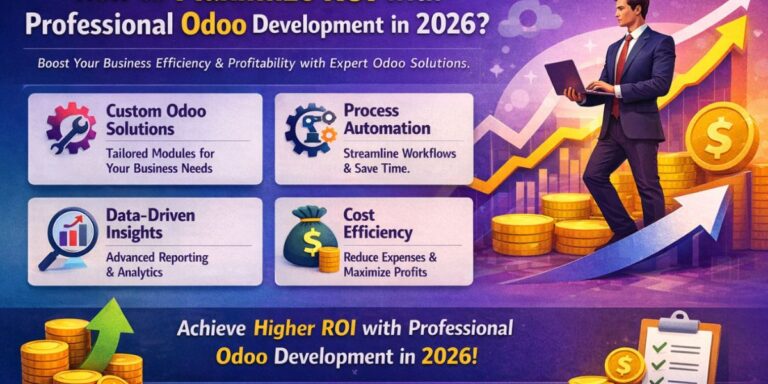
In 2026, companies are no longer adopting Odoo just to manage operations. They are investing in professional Odoo development to fix their broken workflows.
Let’s find out how Odoo can actually help your business.
What actually changed with Odoo Implementation in 2026?
Odoo has grown really well. It is no longer just a collection of useful modules. It has a CRM, accounting, inventory, HR, manufacturing, subscriptions, eCommerce – everything you nee dto run your business. Most importantly, all these segments run on a shared database.
This makes Odoo powerful. But power alone doesn’t translate into returns. Many businesses still struggle because they think that Odoo is like a plug-and-play tool. You just have to enable modules, add users and you are good to go.
Well, that’s not how it is done. If you want a good ROI, it depends on how Odoo is designed around the business. That’s why Odoo development services play a major role in how well you adapt Odoo.
One system instead of five different ones
Using different systems/tools for different departments can really cost high. Different platform fees can pile up and cost you a lot more than you ever planned. It massively impacts your ROI.
Odoo implementation services focuses on combining everything a business would need. It is not just about Odoo migration services but rebuilding workflows so they actually belong together.
When you have one database and one workflow, you will have accuracy. The data will be correct and nullify the chances of making errors.
This is usually the first point where companies start seeing measurable ROI from Odoo. There will be fewer subscriptions, fewer sync issues, and fewer manual reconciliations.
Automation removes friction and not flexibility
A lot of Odoo automation benefits are missed because it’s built blindly with generic rules, rigid flows, and no room for exceptions.
However, when you hire Odoo developers, they approach automation differently. They don’t automate a particular task. They automate decisions that don’t need human involvement.
For example, you have approvals that follow real authority structures. This can be automated. You can set notifications that trigger only when something actually needs attention.
This kind of Odoo customization directly impacts ROI. Here, it is not replacing people but freeing them from repetitive work. They can focus on tasks that require actual decision-making.
Your team will feel valued when they are able to provide their value to work. This directly impacts their productivity levels as well.
Data is more important than dashboards
Most companies say they want better dashboards. But their actual need is better data. Because disconnected systems create arguments. And arguments slow down decisions.And this impacts on ROI.
But Odoo already gives you a unified data model. Odoo ERP development company ensures that the model matches how your business operates. There will be no generic charts, but charts with fields that you want to see. You can generate reports with data as per your business requirements.
Your leadership team will have numbers that will help them make better decisions. You can also read more about how all these modules and dashboards can help your business in the Odoo development guide.
Scaling without optimizing
This is where many businesses regret earlier decisions. When businesses grow, they add new product lines, expand into different locations, and open the door for new markets. But when all this doesn’t sync well, the system feels fragmented.
That is why professional Odoo development in 2026 is done with scale in mind from day one. Odoo helps you keep your structures clean. It uses modular logic, future-safe customizations, and there is clear separation between standard and custom code.
So when growth happens, you can extend your system. You don’t have to start restructuring everything. This also saves years of re-implementation costs later.
Speed that saves your team from burnout
Speed does not mean you have to rush deployments. It is all about removing the internal drag. When your sales, finance, inventory, and operations work inside one Odoo system, sharing becomes invisible.
The sales team can easily close the deal, and the finance team will already have everything that they need. The team doesn’t need to mail every time there is a new customer.
It is for sure that professional Odoo development reduces the friction businesses don’t even realize they are dealing with.
And that kind of speed compounds ROI quietly.
Why bad implementations cost more than no ERP at all
No matter how good the ERP is, a poorly implemented ERP will not only impact the ROi but will disrupt all your workflows. Your team will resist using it. They will simultaneously manage spreadsheets. This is like going back to square one.
But Professional Odoo developers focus heavily on structure, documentation, and upgrade-safe customizations. Hence, even maintenance doesn’t become a recurring surprise cost. Even when the processes evolve, your ERP evolves with you.
User adoption is not a soft metric
Most companies talk about ROI as money saved. But the actual ROi depends on the way the new system is adapted.
If your team finds Odoo confusing, they will avoid it. If the team avoids it, the data quality will not improve, nor will the process speed up, nor will the ROI increase.
That is why you need Odoo customization services to make a real difference.
Professional Odoo developers don’t just focus on backend logic. They help you simplify screens, reduce clicks to smooth the flow. They can help you create role-based views that match what users actually do all day.
For example, the sales team will have access to sales data, similarly finance team will have access to all the finance data. Teams will only have access to the data they need and not everything.
Why flexibility matters more than features
Businesses will grow, which means processes will change. The market might change, or there is a change in strategy.
One of the biggest advantages of Odoo Implementation in 2026 is flexibility. But if it is implemented correctly.
With the Odoo development company:
- Workflows can evolve without rewriting everything
- New modules can plug into existing logic
- Customizations are done in a way that they don’t block future upgrades.
This matters more than businesses realize. If the system is not flexible, lock-in kills ROI over time.
The real cost of professional Odoo development in 2026
This is the question everyone asks eventually.
“How much does professional Odoo development cost?”
There’s no single number. Cost will depend on:
- Your business complexity
- Number of custom workflows
- Integration required
- Whether you need ongoing Odoo development services or a one-time build
If you hire a team in the US, UAE, or Europe, it will cost you more as the developer charges are higher in these regions, compared to countries like India. Having an offshore team in India can be the most cost-effective Odoo solution for a business as the developer charges are less. The reason behind lower hourly rates is the lower cost of living. You will get good developers at affordable rates without compromising on quality.
But here’s the part that matters more than hourly rates. You’re not paying for development hours.
As a business, you are paying to eliminate inefficiencies that cost you money every single month. That’s how smart teams calculate ROI.
Why cheap implementations cost more later
Some companies try to save money by cutting corners early. If you start with minimal planning, imply heavy shortcuts and try to custom code fast, trouble is your way.
It might work for a while, but when upgrades come in, it will start breaking. The performance slows down, and no one will realize what, how, or when things started going wrong.
Professional Odoo development avoids this trap by focusing on:
- clean architecture
- upgrade-safe extensions
- documentation that future teams can understand
When you take the help of professional services, maintenance stays predictable, upgrades do not feel overwhelming, and definitely your system doesn’t turn into a liability.
ROI comes from intent, not tools
Odoo is powerful. But tools don’t create ROI on their own. The intent does.
Companies that maximize ROI with Odoo:
- treat it as a long-term system
- invest in proper Odoo customization services
- choose professional Odoo development over quick fixes
- They don’t chase features.
- They design workflows.
- They build once.
That’s how Odoo digital transformation can quietly become one of the highest-ROI decisions a business can make in 2026.
