

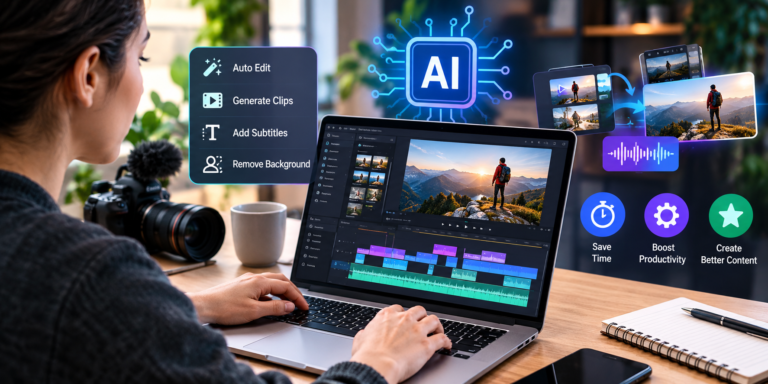
Video production has always involved a mix of scripting, shooting, editing, sound design, captions, and close post-production. Artificial intelligence is transforming that workflow by assisting creators to accomplish a lot of these steps in a shorter time. The current AI video editors can help with cutting out some undesirable parts, making captions, enhancing sound, creating mini-videos, and formatting content to fit various platforms.
ChatGPT can also be useful in such an undertaking. It may assist creators with generating ideas to create videos, scripts, enhancing hooks, generating captions, creating scene descriptions, and creating detailed prompts to the video-generation or editing software. Nevertheless, ChatGPT can not be equated with a full-fledged video editor. It is especially useful as a creative aid in conjunction with specific video tools.
What Is an AI Video Editor?
An AI video editor is software that uses artificial intelligence to automate or assist with editing tasks. Rather than spending time searching through all of the clips, editing all the captions, or deleting all the pauses, creators can accelerate repetitive processes of production with the help of AI.
Natural-language instructions are being more and more favored by modern editors. As an illustration, an author might desire to cut out lengthy breaks, insert subtitles, reorient a horizontal video into a vertical one, or locate the best parts of a recording. Some or all of these tasks can be automated by AI, depending on the software.
This does not exclude human judgment. It is still up to the editors to determine whether a cut is sensible, whether the timing suits the viewer, and whether the video completely conveys the intended message.
How ChatGPT Fits Into Video Editing
Before the editing process, ChatGPT can be helpful and during it. A creator is able to supply information regarding the topic, audience and length and style of the video and request a full production plan.
To give an example, ChatGPT can be used to create:
– Introductions and video scripts.
– YouTube headings and texts.
– Short-form video hooks
– Scene-by-scene outlines
Voiceover scripts
– Subtitle and caption ideas
– Calls to action
– AI video generator prompts.
– Social media descriptions
A real-world example could be a ChatGPT-created script, which could be followed by video recordings created by the author, and the last step could be an AI-based editor. This makes creative planning distinct and separate to technical editing and enables AI to assist in both planning and editing processes.
Using an AI Video Editor With ChatGPT
To creators looking to find an AI video editor using ChatGPT, the best way to approach it is to consider the two technologies complementary and not replaceable.
ChatGPT will be able to process the language-intensive part of production, whereas an AI video editor will be able to operate with footage, timelines, audio, captions, and visual materials. It is a combination that can help the content production be organized.
As an illustration, an artist who created a five-minute educational video might request ChatGPT to translate a subject into a script. Once the video is recorded, an AI editor might be able to transcribe the footage, remove unnecessary pauses, create captions and produce shorter clips to be shared on social media.
Other more recent editing systems are further shifting to conversational workflows. Plain-language editing instructions can be comprehended by AI assistants, and professional software is starting to implement AI functionality directly in established editing environments.
Important Features to Look For
All video editors based on AI do not offer the same features. Creators ought to take into account the following features before selecting software.
– Automatic Captions
Accessibility and social media videos can be facilitated by using the correct captions. AI transcription has the potential to save a lot of time than typing dialogue manually.
– Silence and Removal of Fillers
In the case of interviews, podcasts, tutorials, and talking-head videos, pause and redundant words can be automatically identified, which can make them much quicker to edit.
– Smart Reframing
One video can have to be published in multiple formats. The AI-assisted reframing can be used to reframe landscape shots on vertical surfaces without having to manually reposition each shot.
– Audio Enhancement
Video quality can be compromised by background noise, uneven volume and poor dialogue. Ai audio applications can be used to clean up audio recordings and make speech easier to comprehend.
– Short-Form Repurposing
Long videos may also have a number of moments that can be converted into a short clip. AI is able to recognize possible highlights and format them into such formats as Shorts and Reels.
– Text-Based Editing
Other editors produce a transcript and enable users to make edits to the video by modifying the text. This method might be particularly convenient when it comes to interviews and oral material.
AI Editing vs. AI Video Generation
Another important aspect to note is the distinction between AI video editing and AI video generation.
The work of an AI editor typically involves working with existing footage. It can enhance, arrange, abridge, or reformulate recorded material.
An AI video generator, conversely, has the capability to generate new visual content based on prompts, images or other input. Generation and editing are offered on some platforms, however, the tasks are different.
The decision between them is dependent on the project. An editor of a recorded podcast requires other abilities compared to a marketer producing a completely synthetic product video.
Why Human Creativity Still Matters
A lot of technical work can be automated using AI, and not all creative choices are automatically comprehended. The characteristics of a good video are determined by story telling, time, emotion, consistency in the view, and knowledge of the target audience.
Innovators must thus consider AI as a helper and not as an unquestioning substitute to creative decision-making. The most effective workflow is usually associated with providing AI with clear instructions, analyzing its outputs, and making decisions manually.
The Future of Video Creation with AI
AI video technology is also going towards more conversational and integrated workflows. Creators can also rely on natural-language instructions to coordinate multiple phases of production, rather than alternating between distinct tools to create scripts, edit, generate captions, audio, and visual content.
The change may mean that professional-looking video will be accessible to the novice and experienced editors will spend less time on manual work. The already existing AI editing software is already showing this trend with automated editing, transcription, content repurposing, and natural-language controls.
Finally, AI can be used in video making in the most efficient way not merely by creating faster content. It is eliminating repetitive work and thus creators are able to spend more time on ideas, storytelling and the quality of the end product.
