

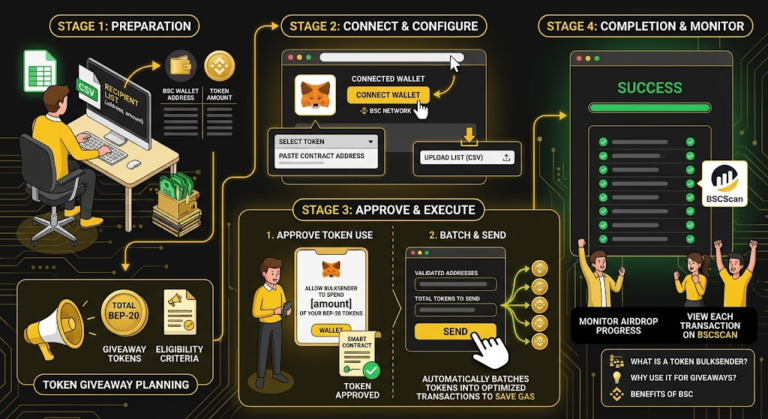
Running a token giveaway or airdrop for hundreds or even thousands of wallet addresses is impractical if you send each transfer one at a time. Every individual transaction on Binance Smart Chain (BSC) costs gas and takes time to confirm, and doing this manually for a large recipient list quickly becomes expensive and error-prone.
This is the problem a token bulksender (also called a multisender or batch transfer tool) solves. It lets a project or community manager send BEP-20 tokens to a large list of addresses in a single, or dramatically reduced number of, on-chain transactions — cutting both gas costs and the time it takes to distribute a giveaway.
What a Bulksender Actually Does
At a technical level, a bulksender is a smart contract paired with a simple web interface. Instead of your wallet initiating a separate transfer for every recipient, you send one transaction to the multisender contract, which then loops through your recipient list and distributes the tokens internally. The result is a single approval and a single (or small number of) transaction fee, rather than one fee per recipient.
This makes bulksenders popular for:
- Community giveaways — rewarding followers, Discord/Telegram members, or contest winners
- Airdrops — distributing a new token to early holders, NFT owners, or a snapshot list
- Payroll or vesting-style payouts — sending recurring token amounts to a fixed group of wallets
- DAO or staking rewards — distributing yield to a list of participants
Step-by-Step: Running a Giveaway on BSC
1. Connect a BSC-compatible wallet Use MetaMask, Trust Wallet, or another wallet configured for the BSC network, and connect it to the multisender platform you’re using.
2. Select the token to distribute Point the tool at the BEP-20 token contract address you want to send. The platform will typically pull the token’s symbol, decimals, and your current balance automatically.
3. Build your recipient list Most tools support two input methods:
- Pasting addresses manually (fine for small lists)
- Uploading a CSV file with wallet addresses and the amount each address should receive
A typical CSV format looks like:
0xAbC123...111,50
0xDeF456...222,50
0x789Ghi...333,100
This lets you send a flat amount to everyone or customize amounts per wallet — useful if rewards are tiered by contribution, holding size, or contest placement.
4. Approve the token allowance Before the contract can move tokens on your behalf, you’ll need to sign an approval transaction that authorizes the multisender contract to spend the required amount from your wallet.
5. Execute the batch transfer Confirm the final transaction. Depending on list size and the specific tool, this may be split into a few batches if the recipient count is very large, but it will still be far fewer transactions than sending one by one.
What You Need Before You Start
- BNB for gas — even though you’re batching transfers, the transaction that executes the batch still needs BNB to cover network fees. Larger lists generally require more gas, so estimate this in advance.
- Full token balance in your wallet — your wallet needs to hold the entire cumulative amount you plan to distribute before launching the transfer. If the total across your CSV exceeds your balance, the transaction will fail.
- A clean recipient list — duplicate addresses, malformed addresses, or exchange deposit addresses (which usually can’t receive giveaway tokens correctly) are common causes of failed or lost distributions. It’s worth validating the list before uploading it.
- A test run — for large or high-value giveaways, sending a small test batch to a couple of addresses first can catch formatting or contract issues before you commit the full list.
Choosing a Bulksender Tool
Several tools support BEP-20 batch transfers on BSC, generally falling into two categories:
- Chain-specific multisender dApps — built specifically for BSC (or multi-chain with BSC support), often listed in BNB Chain’s dApp directory. These tend to have simpler, more BSC-tailored interfaces.
- General-purpose bulksender platforms — support multiple EVM-compatible chains (BSC, Ethereum, Polygon, etc.) from one interface, useful if you run giveaways across more than one network.
When evaluating a tool, it’s worth checking that the underlying smart contract is verified on BscScan, has been used for a reasonable transaction volume already, and — where available — has been audited. Since you’re granting a token allowance and the tool moves your tokens directly, using an unfamiliar or unverified contract carries real risk.
A Quick Pre-Launch Checklist
- Recipient list finalized and deduplicated
- CSV format matches the tool’s required structure
- Wallet holds full token amount needed
- Wallet holds enough BNB for gas
- Multisender contract verified on BscScan
- Small test batch sent successfully
- Full distribution executed and transaction hash recorded for transparency
Following this process, a giveaway that would otherwise take hours of manual sending — and cost far more in cumulative gas fees — can be completed in a single session with full control over exactly who receives what.
