

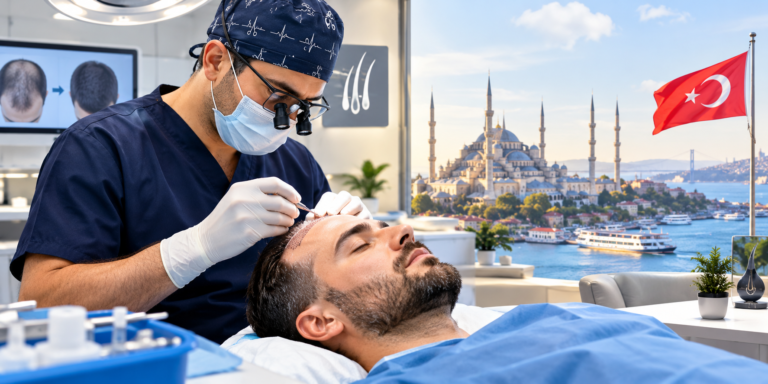
Turkey performs more hair transplants than any other country in the world. Every year, hundreds of thousands of international patients fly into Istanbul for a procedure that costs a fraction of what it does in London, New York or Sydney. For over a decade, the industry’s growth story has been written in volume: multi-chair clinics, all-inclusive packages with hotel and transfers, and prices that undercut Western Europe and North America by two-thirds or more.
But a quieter shift is now under way. A growing segment of international patients — particularly from the UK, the US, Canada and Northern Europe — is no longer shopping on price alone. They are asking a different, more pointed question: who, exactly, is going to operate on me?
How the high-volume model works
The economics of the high-volume clinic are simple. A single surgeon can oversee several operating rooms at once if the labour-intensive parts of the procedure are handed to technicians. Those parts are the extraction of individual follicular units from the donor area at the back of the head, and their implantation into the thinning zones.
With that division of labour, ten or more patients a day become feasible. Fixed costs are spread across more cases, and the price per procedure falls accordingly. Package deals, aggressive online advertising and referral commissions do the rest.
For patients, the offer is attractive on paper: a well-known destination, a modern facility, an English-speaking coordinator and a price that seems too good to refuse. In many cases, the outcome is acceptable. In many others, it is not — and the difference is rarely visible at the point of booking.
Where the trade-off shows up
The trade-off is clinical, and it is delayed. Graft survival depends on three things: how carefully each follicle is extracted without damaging its root, how long it spends outside the body before implantation, and how precisely it is placed for angle, depth and direction so that it grows like the surrounding hair.
These are the steps most often delegated in a high-volume setting. A technician working quickly through a large session may transect a percentage of grafts during extraction; grafts waiting in a dish for hours lose viability; implantation done without attention to natural growth patterns produces a hairline that looks dense but artificial.
Patients do not see any of this in the brochure. They see it twelve to eighteen months later, when the final result has grown in: thinner density than expected, a hairline that sits too low or too straight, or visible scarring across a donor area that was over-harvested in a single session. The remedy is a second procedure — this time drawing on a donor supply that has already been depleted, and often at a higher price than the first.
A different operating model
Against this backdrop, a small number of Istanbul clinics have built their reputation on the opposite premise: one patient per day, with the surgeon personally performing the critical stages of the operation.
Throughput is lower, and prices sit above the market floor. But they remain well below what the same procedure costs in the United Kingdom or the United States, which means the destination’s fundamental advantage — specialist care at a sustainable price — is preserved. What changes is the allocation of the surgeon’s time.
Dr. Arslan Musbeh, founder of Hairmedico in Istanbul and a faculty instructor on the university hair restoration diploma course at Université Claude Bernard Lyon 1, is one of the surgeons who has made this model his clinic’s identity. His team has also developed a structured planning method, branded Algorithmic FUE, that maps the donor area and calculates graft distribution zone by zone before the first extraction is made. The aim is to make the surgeon’s judgement systematic and repeatable, rather than improvised on the morning of the procedure.
“The number of grafts is the easiest thing to sell and the least useful thing to promise,” he says. “What matters is how many of them survive, whether they are placed where they will make the biggest visual difference, and whether the plan leaves the patient with options in ten years’ time.”
What informed patients are now checking
Clinics that follow the surgeon-led model tend to attract patients who do their homework, and over the past few years the checklist has become fairly standard.
Prospective patients ask who performs extraction and implantation, not just who does the consultation. They ask how many procedures the clinic schedules on the same day. They look for a recognised specialist affiliation — membership of professional bodies such as FUE Europe is one signal — and for evidence that the surgeon teaches, publishes or is otherwise accountable to peers.
They ask for a written graft plan rather than a “maximum number”, and they want to know how the donor area will be protected for future sessions. They ask what happens after they fly home: photo reviews at set intervals, a direct line to the medical team rather than a sales coordinator, and, increasingly, the possibility of an in-person follow-up consultation in their own country.
For patients researching a hair transplant in Turkey, those questions now shape the decision far more than the headline price. Online forums, video reviews and independent comparison sites have made the differences between clinic models visible in a way they were not five years ago.
The economics of doing fewer cases
It is worth asking why a surgeon would choose to do one case a day when the market rewards doing ten. Part of the answer is medical: a full day allows for meticulous extraction, minimal time out of body, and unhurried implantation of several thousand grafts. Part of it is reputational: a surgeon-led clinic lives or dies by its long-term results and by word of mouth among a well-informed patient community.
And part of it is simply that the surgeon-led segment has found its own market. Patients who have already seen a poor result — their own or a friend’s — are willing to pay more for accountability. So are older patients, patients with limited donor supply, and anyone for whom a second corrective procedure is not an option.
The market implication
None of this suggests the volume model is disappearing. It serves a price-sensitive segment that remains very large, and for straightforward cases it can deliver acceptable results.
But the emergence of a surgeon-led tier is changing how the Turkish market is perceived abroad. It gives international patients a way to separate medical quality from geography — to choose Istanbul for its expertise and infrastructure rather than despite its reputation for bargain packages. And it gives Turkish medicine a reputational argument that goes beyond cost.
For a sector too often discussed in terms of flight bundles and hotel stars, that is a meaningful change. The clinics that benefit will be those able to prove, not merely claim, that the person holding the instrument is the surgeon whose name is on the door.
