

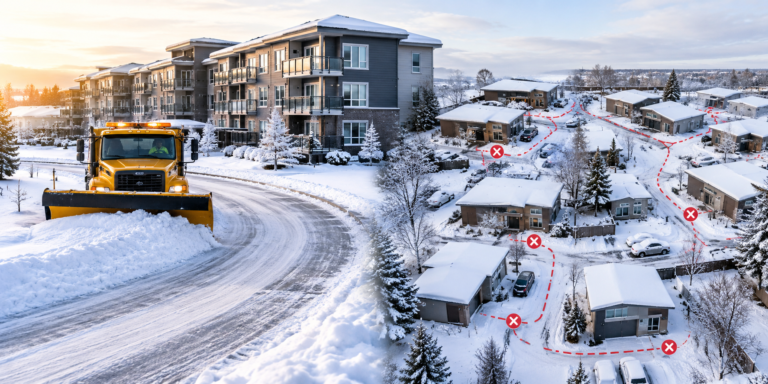
Fragmentation Changes the Route Before the Storm Starts
The Biggest Strata Property Is Not Always the Hardest—The Most Fragmented One Is: Why Broken-Up Sites Break Simple Snow Routes
A large strata property can look intimidating on a site plan. More pavement, more buildings, more parking, and more walkways usually suggest more winter work.
But size alone does not determine operational difficulty.
A smaller property divided into disconnected lanes, separate parking courts, narrow pedestrian paths, multiple entrances, hidden service areas, and isolated building clusters can consume more time than one large, continuous site.
That is the core challenge of fragmented property snow route planning.
The crew is not simply clearing square metres. It is moving between work zones. Equipment has to turn around, reposition, travel through already serviced sections, wait for parked vehicles, and sometimes switch from machine work to hand clearing several times within one property.
For winter route planning for Surrey strata communities, understanding this internal fragmentation before the first storm is often more valuable than knowing the property’s total paved area.
The most difficult site may be the one where every completed section creates another transition.
Site Mapping for Fragmented Properties
A standard site map tells crews where roads and buildings are. A useful winter map should tell them how the property actually needs to be serviced.
That means separating the site into operational zones.
Map Connections, Not Just Surfaces
Consider a property with three parking courts connected by narrow lanes.
On paper, the total paved area may be moderate. Operationally, each court can behave like a separate mini-property.
Crews need to know whether a truck can enter and exit without reversing long distances, where equipment can turn around, which sections become blocked by parked cars, and whether one snow-storage location interferes with access to the next zone.
Walkways create another layer.
A machine may clear an internal road efficiently, but the crew might then need to park, unload hand tools, clear several entrances, return to the vehicle, and relocate before reaching the next pedestrian cluster.
Those transitions deserve to be mapped.
Snow Storage Can Divide the Site Again
Storage locations can make a fragmented property even more difficult as the season progresses.
A pile placed beside a narrow connector may reduce turning space. Snow stored between two parking courts can block the most efficient equipment route. A pile that works during the first storm may force longer travel paths after several events.
Winter mapping should therefore show both primary and backup storage zones.
The goal is to preserve movement through the property, not simply find somewhere to place the first accumulation.
Bigger Is Not Always Slower—Disconnected Is
A large open parking area offers something snow crews value: continuity.
Once equipment begins a pass, it can often keep working. There are fewer stops, fewer transitions, and less time spent repositioning.
Fragmented sites remove that efficiency.
A truck may complete one lane and then need to reverse out. A skid steer may be better suited to one parking court but unnecessary for the next. Hand crews may have to cross areas that machinery cannot reach.
This is where assumptions based only on acreage or total pavement can produce weak service estimates.
Two properties with the same clearing area may require very different service times.
Effective fragmented property snow route planning considers how many times work has to stop and restart.
Every gate, dead end, narrow corner, pedestrian-only connection, change in surface type, and equipment transition adds operational time.
That time matters during regional storms because one unexpectedly complex property can affect every property scheduled after it.
Crew Sequencing and Equipment Allocation
Fragmentation also changes how crews should be deployed.
Sending the biggest available machine to a complicated site does not necessarily make the work faster.
Handwork and Machine Work Need Different Clocks
Machine clearing and pedestrian work often progress at very different speeds.
If a truck completes vehicle routes quickly but hand crews still have five separated entrance clusters to service, the property is not operationally finished.
A better plan sequences tasks according to priority.
Main access may need to open first. High-traffic walkways may follow. Secondary parking sections can then be completed without holding up the routes residents need most.
This prevents the crew from treating the property as one long checklist where every surface carries equal urgency.
Return Paths Matter
Crews also need to think about where equipment will be after each task.
A route that looks efficient in one direction may leave the truck trapped at the wrong end of the property.
Likewise, clearing a narrow connector too early may later send additional traffic over a surface crews still need to treat.
Good sequencing minimizes unnecessary backtracking.
That is particularly important during continuous snowfall, when areas serviced earlier may require another pass before the property is fully stabilized.
The Hidden Cost Is Repositioning, Not Acreage
Fragmented properties consume time in ways residents rarely see.
The visible work is plowing, shovelling, and applying ice-control material. The invisible work is moving between those tasks.
Crews reposition equipment. Drivers navigate narrow internal roads. Workers move tools between entrances. Trucks wait while parked vehicles clear a route. Operators travel back to a snow-storage zone because the next section has nowhere suitable to push accumulation.
None of that adds square footage.
All of it adds service time.
This is why contractor capacity matters.
Only Strata Snow Removal maintains strict capacity limits rather than treating every additional property as interchangeable route volume. A complicated strata site can require more operational attention than its size suggests, and accepting too many such properties can undermine response reliability across an entire storm route.
Proactive dispatch also helps when changing conditions require crews to revisit only certain zones instead of repeating the full property.
Large salt reserves support the same approach during freeze-thaw events, when several disconnected walkways or access points may require targeted treatment even after mechanical clearing is complete.
Documentation and Route Reliability
Fragmented sites also make documentation more important.
A single photograph of an entrance cannot represent five parking courts, several walkways, multiple stair clusters, and disconnected internal roads.
GPS and photo service logs can provide a clearer record of which portions of the property were reached, when work occurred, and what conditions crews encountered.
For Only Strata Snow Removal, that documentation fits into a broader strata-only operating model. Shared residential sites often contain the exact complications that generic commercial route assumptions overlook: multiple resident access points, visitor parking, waste areas, parkade ramps, pedestrian corridors, drainage zones, and snow-storage constraints.
The company’s damage repair guarantee and cancellation flexibility address additional concerns in the service relationship, while its route planning, proactive dispatch, material readiness, and capacity controls are aimed at reliable winter response.
The practical lesson for strata councils and property managers is straightforward: do not evaluate winter complexity by property size alone.
Count the transitions.
How many disconnected work zones exist? How many times must equipment stop and reposition? Where can crews turn around? Which areas require hand service? How many snow-storage locations remain usable after several storms? Can the same route still work when parked vehicles, new accumulation, and existing snow piles reduce available space?
Those questions reveal far more than acreage.
A large, continuous property may allow crews to work steadily from one end to the other.
A smaller fragmented one can force them to solve the route again at every corner.
And in winter operations, the hardest property is often not the one with the most ground to clear—it is the one with the least continuity.
