

Choosing a Dynamics 365 partner is rarely just a question of who can implement the software.
The more important question is whether that partner can understand how your business operates, challenge weak processes, make sound architectural decisions, and remain accountable after the system goes live.
That distinction matters because a Dynamics 365 project does not end with implementation. Decisions made during discovery, configuration, integration, migration, and deployment can shape the platform for years. A partner that looks capable during the sales process may not necessarily have the depth to support the environment when requirements change or problems emerge.
For decision makers, D365 partner selection therefore needs to go beyond certifications and product familiarity. The right evaluation should consider implementation experience, industry knowledge, technical capability, migration expertise, support models, and the partner’s ability to work as a long-term technology advisor.
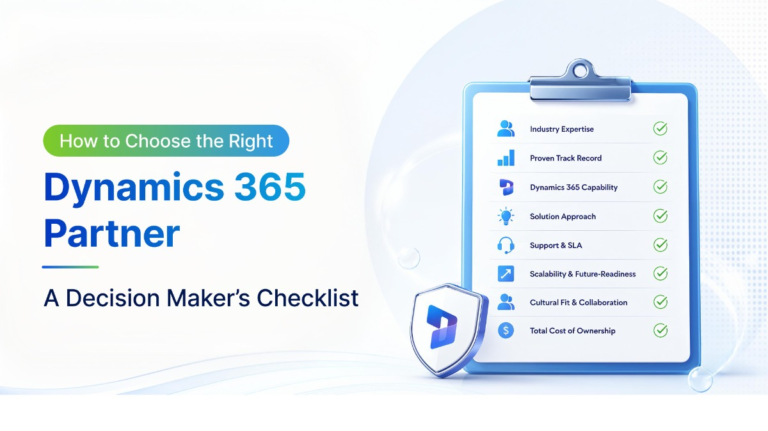
Here is a practical checklist to help make that evaluation more rigorous.
Start With Business Understanding, Not Product Knowledge
A capable Microsoft Dynamics 365 Partner should be able to discuss your business before discussing configurations.
During initial conversations, pay attention to the questions the partner asks.
Are they trying to understand your operating model, approval structures, reporting requirements, integrations, compliance needs, and growth plans? Or are they moving quickly toward a predefined solution?
This distinction can reveal a lot.
Dynamics 365 can be configured in many ways, but not every technically possible configuration is appropriate for the business. An experienced partner should be willing to challenge unnecessary customization, identify process improvements, and explain where standard capabilities are preferable.
What to check:
- Understanding of your industry and business processes
- Ability to translate requirements into platform capabilities
- Approach to customization versus standard functionality
- Experience handling complex business scenarios
- Willingness to identify process improvements rather than simply reproduce existing processes
Evaluate Implementation Capability Beyond the Demo
A polished product demonstration tells you very little about how a partner handles a complex implementation.
A strong Dynamics 365 implementation partner should have experience managing the less visible parts of the project: solution architecture, integrations, data structures, security, testing, change management, deployment planning, and user adoption.
Ask for examples of projects similar to yours, not just a list of customers.
Look for evidence of how the partner handled difficult requirements, integration dependencies, data issues, scope changes, or deployment risks.
A useful evaluation should cover the entire implementation lifecycle rather than focusing only on configuration.
Look Closely at Data Migration Expertise
Migration can become one of the most underestimated risks in a Dynamics 365 project.
Legacy systems often contain duplicate records, inconsistent master data, obsolete transactions, custom fields, and years of accumulated business logic. Moving that information into a new environment without proper analysis can transfer existing problems into the new platform.
This is where experienced Dynamics 365 migration services become valuable.
A capable partner should have a defined approach for data assessment, cleansing, mapping, transformation, validation, reconciliation, and cutover.
Ask how migration will be tested and how the partner will confirm that critical records remain accurate after the move.
The objective should not be to migrate everything simply because it exists. It should be to migrate the information the business actually needs in a reliable and controlled manner.
Integration Capability Should Be Part of the Evaluation
Dynamics 365 rarely operates as an isolated system.
ERP, CRM, eCommerce, payment platforms, warehouse systems, shipping providers, HR applications, analytics platforms, and external business applications may all need to exchange information with the environment.
That makes integration architecture an important part of D365 partner selection.
Ask potential partners:
- Which integration platforms and patterns do they typically use?
- How do they handle real-time versus batch integrations?
- How are integration failures monitored?
- How is data consistency maintained?
- Who owns integration support after deployment?
A partner may be excellent at Dynamics 365 configuration but still struggle with the broader technology ecosystem surrounding it.
Do Not Treat Support as an Afterthought
The first few months after go-live can reveal more about a partner than the implementation itself.
Users encounter unfamiliar workflows. Integrations require monitoring. Performance issues emerge under real workloads. New requirements appear. Microsoft releases platform updates that need assessment.
This is why Dynamics 365 support services should be evaluated before signing the implementation contract.
Ask what happens after go-live.
Will support be handled by the same team that understands your implementation? Are response times clearly defined? Is there proactive monitoring? How are recurring issues analyzed? Can the partner support enhancements as well as incidents?
A strong support model should help the environment improve over time, not simply react when something breaks.
Assess the Depth of Managed Services
For organizations that do not want to maintain a large internal Dynamics team, D365 managed services can provide another layer of operational support.
However, managed services should not simply mean outsourcing the help desk.
A mature model may include application monitoring, performance optimization, security reviews, release management, proactive issue identification, environment management, and continuous improvement.
Decision makers should therefore understand exactly what is included in the managed service agreement, which responsibilities remain internal, and how the partner measures service quality.
Examine the Team, Not Just the Company
The logo on the proposal is not the team delivering the project.
Ask who will actually work on the engagement.
Understand the experience of the solution architects, functional consultants, developers, integration specialists, data professionals, and project managers assigned to the project.
It is also worth asking how the partner handles knowledge continuity. If key consultants leave halfway through the project, there should be a structured way to transfer knowledge without disrupting delivery.
A large partner is not automatically a better partner. Depth, accessibility, communication, and relevant experience often matter more than headcount alone.
Check Their Approach to Governance and Security
Dynamics 365 implementations involve sensitive financial, customer, employee, and operational information.
Security should therefore be part of the architecture from the beginning rather than a final checklist before deployment.
Ask how the partner approaches role design, segregation of duties, access controls, environment management, auditing, and compliance requirements.
Also evaluate how governance will continue after implementation.
A strong Dynamics 365 partner should be able to explain how security decisions are documented, reviewed, and maintained as the environment evolves.
Look for a Partner That Can Stay Ahead of the Roadmap
Dynamics 365 is not a static product.
Microsoft continues introducing new capabilities across Dynamics 365, Power Platform, Azure, Copilot, data, and AI. The partner you select should understand how these developments could affect your environment rather than simply maintaining what was implemented several years ago.
This is particularly important when planning future modernization.
The right partner should be able to distinguish between technology that creates genuine business value and technology that simply adds complexity.
That long-term perspective is what separates an implementation vendor from a strategic technology partner.
The Final Decision Should Come Down to Fit
There is no universal formula for choosing a Dynamics 365 partner.
The right choice depends on your organization’s size, industry, technical maturity, implementation scope, internal capabilities, and long-term objectives. A partner that is ideal for a straightforward deployment may not be equipped for a global transformation involving multiple business units, legacy migrations, integrations, and ongoing managed services.
Before making the final decision, evaluate the partner across the complete lifecycle:
Business understanding → Architecture → Implementation → Migration → Integration → Adoption → Support → Continuous improvement
That broader evaluation gives decision makers a much clearer picture of what they are actually buying.
Ending Note
A Dynamics 365 investment can deliver significant operational value, but the platform itself is only one part of the equation. The expertise surrounding it can determine how effectively that investment performs over time.
The right Microsoft Dynamics 365 Partner should bring more than implementation resources. It should bring business understanding, technical depth, migration expertise, dependable Dynamics 365 support services, and the ability to evolve the platform as your organization changes.
For decision makers, the best partner is therefore not necessarily the one with the longest feature list or the lowest initial proposal. It is the one that can demonstrate how it will help your Dynamics 365 environment perform today while preparing it for what comes next.
