

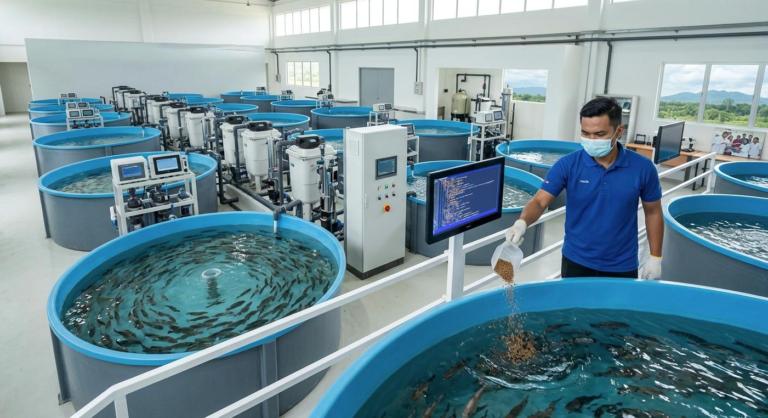
Running a fish farm involves more than feeding fish and maintaining ponds. Farmers must manage feed expenses, electricity consumption, water quality, labor, and equipment maintenance while keeping fish healthy and production consistent. When these costs are not properly controlled, even a productive fish farm can struggle to remain profitable.
A smart aquaculture system offers a practical approach to managing these challenges. By combining digital monitoring, automated equipment, and data-driven decisions, fish farmers can identify unnecessary expenses and improve how resources are used.
Instead of relying entirely on manual work and traditional farming methods, modern aquaculture technology provides better visibility into daily operations. Farmers can monitor important conditions, manage equipment more efficiently, and respond to potential problems before they become expensive.
Here is how to economize a fish farm using a smart aquaculture system without compromising fish welfare or production quality.
What Makes a Fish Farm Smart?
A smart fish farm uses connected devices and automated technologies to monitor and manage farming activities. These systems may include water-quality sensors, automatic feeders, oxygen monitoring equipment, digital dashboards, and remote control applications.
The technology collects information about the farm environment and helps farmers make informed decisions.
For example, a dissolved oxygen sensor can monitor oxygen levels in a fish pond. If the reading falls below a predefined threshold, the system can send an alert or activate compatible aeration equipment.
Similarly, automated feeding equipment can distribute measured portions of feed according to a planned schedule.
The purpose is not to automate every farming activity. It is to reduce avoidable waste, improve operational control, and make better use of available resources.
1. Control Feed Expenses with Precision Feeding
Feed is one of the most significant recurring expenses in fish farming. Poor feeding practices can increase operating costs and negatively affect water quality.
Overfeeding means farmers pay for feed that fish do not consume. Uneaten feed can also contribute to organic waste and deteriorating water conditions.
A smart aquaculture system can help address this problem through automatic feeders and feeding-management technology.
Depending on the equipment, farmers can:
- Set feeding schedules according to production requirements.
- Control the quantity of feed distributed.
- Observe feeding activity through cameras or monitoring tools.
- Adjust feeding routines based on fish size and behavior.
- Maintain more consistent feeding records.
Precision feeding does not mean feeding every fish the same amount regardless of its condition. Farmers should consider species, growth stage, water temperature, stocking density, and feeding response.
Better feeding management can reduce unnecessary feed consumption and support more efficient production.
2. Reduce Electricity Costs Through Intelligent Aeration
Electricity is another important expense, particularly in intensive aquaculture operations where aerators, pumps, and filtration equipment operate regularly.
Aeration is essential for maintaining suitable dissolved oxygen levels, but running equipment without considering actual conditions may increase energy consumption.
Smart oxygen monitoring systems can help farmers understand when additional aeration is needed.
For example, dissolved oxygen sensors can continuously measure oxygen concentrations. Compatible control systems may activate aerators when readings reach selected limits.
This approach can help farmers manage equipment according to real conditions rather than relying only on fixed operating schedules.
However, oxygen requirements vary with fish species, stocking density, feeding activity, water temperature, and farming conditions. Farmers should establish appropriate safety thresholds and backup aeration arrangements.
3. Prevent Expensive Water Quality Problems
Poor water quality can create serious financial problems for fish farmers. Changes in oxygen, temperature, pH, and ammonia levels may affect fish health and growth.
Without regular monitoring, farmers might discover problems only after fish begin showing signs of stress.
Smart aquaculture systems use sensors to monitor important water parameters and provide useful information throughout the day.
Common measurements include:
- Dissolved oxygen levels.
- Water temperature.
- pH measurements.
- Ammonia concentrations.
- Water clarity and turbidity.
Some advanced systems can send notifications when readings move outside selected limits.
Early warnings allow farmers to investigate the cause and take appropriate action before a minor issue becomes a major operational problem.
Monitoring equipment does not eliminate the need for proper water testing, but it can make farm management more responsive.
4. Save Labor Costs with Remote Monitoring
Traditional fish farms often require workers to inspect ponds, check equipment, record water conditions, and manage feeding activities manually.
These responsibilities are important, but technology can make some routine tasks more efficient.
Remote monitoring systems allow farmers to review selected farm conditions through mobile applications or computer dashboards.
Depending on the installation, farmers may be able to:
- Check water-quality readings remotely.
- Review equipment operating status.
- Receive alerts about unusual conditions.
- Monitor feeding schedules.
- Maintain digital production records.
This can reduce unnecessary inspection trips and make it easier to supervise multiple ponds or tanks.
However, remote monitoring should never replace essential physical inspections. Workers must still check fish behavior, equipment condition, water appearance, and other important farm conditions.
5. Use Predictive Maintenance to Avoid Equipment Failures
Unexpected equipment breakdowns can be expensive. A failed pump, damaged aerator, or malfunctioning feeder may interrupt farm operations and create risks for fish health.
Smart monitoring tools can help farmers identify certain equipment problems earlier.
For example, some systems can monitor motor performance, operating hours, temperature, and unusual equipment behavior.
These readings may indicate that a machine requires inspection or maintenance.
A preventive maintenance plan should include:
- Regular pump inspections.
- Cleaning and checking aeration equipment.
- Inspecting electrical connections.
- Checking automatic feeders.
- Calibrating monitoring sensors.
- Replacing worn components when necessary.
Maintaining equipment regularly can help reduce unexpected repair expenses and improve operational reliability.
6. Improve Water Management with Recirculating Aquaculture Systems
Water is a valuable resource in fish farming, and managing it efficiently can help control operating costs.
Recirculating Aquaculture Systems, commonly known as RAS, are designed to filter and reuse water rather than depending entirely on frequent water replacement.
A typical RAS setup may include mechanical filtration, biological filtration, pumps, aeration, and water-quality monitoring equipment.
The system removes suspended waste and supports the biological processes needed to manage dissolved waste compounds.
Smart sensors can help operators monitor water conditions and identify when particular parts of the treatment system require attention.
RAS technology can reduce water consumption, but it also involves installation expenses, electricity requirements, filtration maintenance, and technical management.
It is therefore important to evaluate the total operating cost before adopting this approach.
7. Monitor Fish Growth to Improve Production Planning
Understanding how quickly fish grow helps farmers make better decisions about feeding, stocking, and harvesting.
Without reliable records, farmers may find it difficult to compare production results between different farming cycles.
Smart farm-management software can help record:
- Stocking dates and quantities.
- Fish weight measurements.
- Feeding records.
- Mortality information.
- Water-quality conditions.
- Harvest quantities.
By reviewing these records, farmers can identify patterns that may influence production performance.
For instance, if fish growth slows during particular periods, farmers can investigate possible links with feeding practices, temperature, oxygen levels, or stocking density.
Better production records support more accurate planning and help farmers identify avoidable operational expenses.
8. Reduce Fish Losses with Early Warning Systems
Fish mortality can directly affect farm revenue. Environmental changes, equipment failures, and disease outbreaks may cause losses if problems are not identified quickly.
Smart aquaculture technology can provide early warnings by monitoring environmental conditions and, in some cases, fish behavior.
For example, a sudden decline in dissolved oxygen can trigger an alert. This gives farmers an opportunity to check aeration equipment and investigate the situation.
Advanced systems may also use underwater cameras and computer vision to identify changes in swimming or feeding behavior.
These tools cannot diagnose every fish disease, but they can help identify unusual conditions that require attention.
Farmers should combine technology with biosecurity measures, routine observation, appropriate stocking practices, and professional fish-health advice.
9. Use Data Analytics to Identify Hidden Expenses
Some fish-farming expenses are difficult to identify because they develop gradually.
A farmer may notice increasing electricity bills without knowing whether the problem comes from inefficient aeration, pump performance, or changing production requirements.
Smart aquaculture platforms can help organize information about daily operations.
By comparing records from different production cycles, farmers may identify:
- Changes in feed consumption.
- Increasing electricity usage.
- Unusual water-treatment costs.
- Higher equipment maintenance expenses.
- Differences in fish growth and harvest results.
This information helps farmers understand where money is being spent and which improvements deserve attention.
Data analytics is particularly useful when farmers maintain accurate records and review them regularly.
10. Choose Technology According to Your Farm Budget
A common mistake is assuming that every fish farm needs expensive automation.
In reality, the most suitable smart aquaculture system depends on farm size, fish species, production method, available infrastructure, and financial resources.
Small farms may begin with basic dissolved oxygen meters, temperature monitoring devices, and programmable feeders.
Medium-sized farms may benefit from connected water-quality sensors, automatic aeration controls, and digital recordkeeping.
Large commercial operations may consider integrated monitoring platforms, advanced feeding systems, automated filtration controls, and predictive maintenance tools.
Before purchasing equipment, compare the following:
- Initial purchase and installation costs.
- Electricity consumption.
- Sensor accuracy and calibration requirements.
- Maintenance expenses.
- Availability of technical support.
- Compatibility with existing equipment.
- Backup options during power or internet failures.
Starting with a small upgrade can help farmers evaluate the benefits before investing in a complete automated system.
How to Calculate Whether a Smart Aquaculture System Is Worth the Investment
Technology should improve the financial performance of a fish farm, not simply make operations look more modern.
Before installing a smart aquaculture system, farmers should calculate the expected return on investment.
Start by recording current expenses, including feed, electricity, labor, water management, repairs, and equipment maintenance.
Next, estimate which costs the proposed technology could realistically reduce.
A simple calculation is:
Net Annual Savings = Annual Cost Reductions − Additional Annual Operating Costs
The payback period can then be estimated using:
Payback Period = Initial Investment ÷ Annual Net Savings
For example, if a system costs $5,000 and produces $1,250 in net annual savings, the estimated payback period would be four years.
This is only an illustrative calculation. Actual results depend on farm conditions, installation quality, equipment lifespan, maintenance, and production performance.
Farmers should also consider possible improvements in fish survival and production consistency, without assuming that these benefits are guaranteed.
Common Mistakes to Avoid When Economizing a Fish Farm
Reducing expenses should never come at the cost of fish health or farm safety.
Some mistakes can create bigger financial problems over time.
Buying unnecessary technology: Choose equipment that addresses a genuine operational problem instead of purchasing every available smart farming device.
Ignoring sensor calibration: Inaccurate measurements can lead to poor decisions. Follow the manufacturer’s calibration and maintenance instructions.
Reducing aeration too aggressively: Saving electricity is not worth risking inadequate oxygen levels. Maintain appropriate oxygen conditions and backup equipment.
Overlooking staff training: Workers need to understand how to operate monitoring devices, respond to alerts, and handle equipment failures.
Ignoring maintenance: Automated systems still require regular inspection, cleaning, and servicing.
Depending entirely on internet connectivity: Important monitoring and control functions should have suitable backup arrangements where possible.
Final Thoughts
Economizing a fish farm requires more than cutting expenses. It involves understanding where resources are being wasted and finding practical ways to improve daily operations.
A smart aquaculture system can help farmers manage feed distribution, monitor water quality, control aeration, track equipment performance, and make better production decisions.
However, technology alone cannot guarantee profitability. Its effectiveness depends on selecting suitable equipment, maintaining accurate records, training workers, and following responsible fish-farming practices.
For farmers who want to modernize their operations, starting with one major expense, such as feed waste or electricity consumption, can be a sensible approach. A carefully selected smart aquaculture solution may help create a more efficient, reliable, and economically sustainable fish farm.
